
Porting the weekend-gap sleeve to the personal-account EA
Integrating the "wgap" logic and rollover avoidance into my Personal Core V1 system to create what I call version 1.5.0 is now complete.
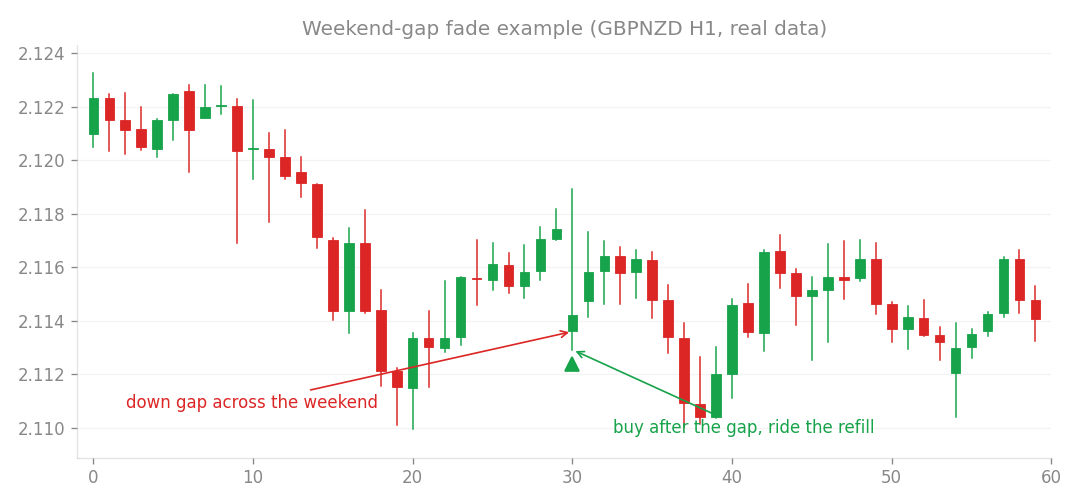
Weekend-gap fade example (GBPNZD H1, real data): trading the refill of a down gap across the weekend.
Integrating the “wgap” logic and rollover avoidance into my Personal Core V1 system to create what I call version 1.5.0 is now complete. However, the update highlights a critical shift in how I need to manage my risk. I have updated the EA to include the wgap sleeve (the same logic used in Core v1.15.0) and the rollover avoidance guard from Core v1.17.0. Crucially, I have synced the risk settings to “Configuration D,” which is my current internal standard. Because Configuration D applies a 1.18x multiplier to the base risk, every “k” setting (the parameter controlling position sizing) is now effectively 18% more aggressive than it was before. To see how this impacts performance, I ran a full backtest from 2015 to 2026.
| Setting | Profit Factor (PF) | Monthly Return | Max Drawdown (DD) |
|---|---|---|---|
| k3 | 1.69 | +1.79% | -23.89% |
| k5 | 1.69 | +2.31% | -36.95% |
| The Profit Factor, or PF, is the ratio of gross profit to gross loss. A PF of 1.69 means the strategy is generating 1.69 dollars for every dollar lost, which is a solid indicator of efficiency. | |||
| The most important takeaway here is the impact on drawdown. My personal “walk-away” limit (the point where I would stop the system due to unacceptable losses) is set at a -35% drawdown. Under the new Configuration D, the k5 setting results in a historical drawdown of -36.95%, which crosses that threshold. In other words, while the higher returns might look tempting, the risk of ruin is now too high for my personal comfort. | |||
| Moving forward, the appropriate range for my personal accounts is now k3 for a conservative approach or up to k4 for a more aggressive stance. I have updated the presets and README files accordingly. While I am currently running this in parallel on an Axiory demo account, the final decision on which “k” to use for live trading remains a matter of individual preference. My next step will be to re-run the Monte Carlo simulations to formally map out the new distribution of risk and drawdown budgets. |
How this connects
This verification builds on earlier ones (what failed before and what I tried this time, comparisons between approaches).