The weekend-gap edge only works in one direction
The edge found in weekend price gaps is unique to the rebound of downward gaps, and this hypothesis does not hold for upward gaps.
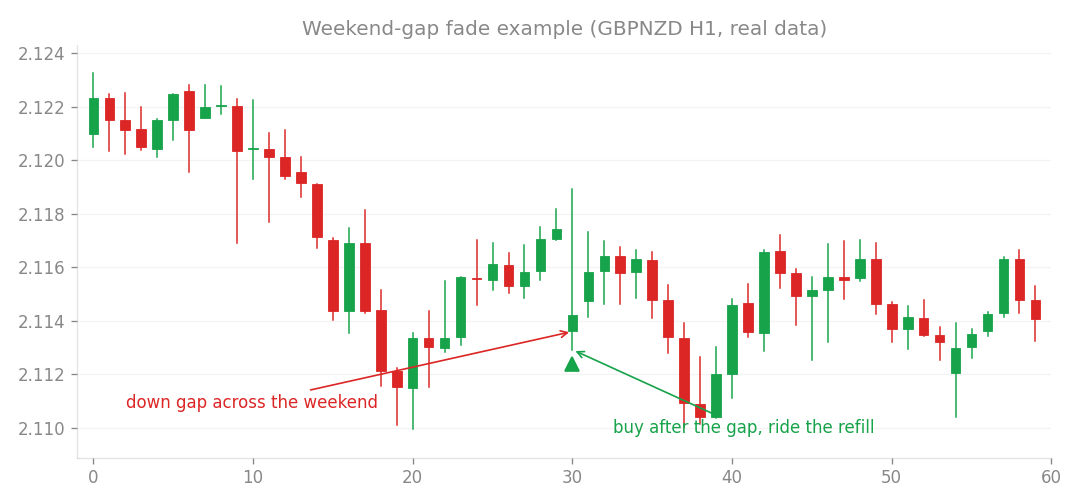
Weekend-gap fade example (GBPNZD H1, real data): trading the refill of a down gap across the weekend.
The edge found in weekend price gaps is unique to the rebound of downward gaps, and this hypothesis does not hold for upward gaps. I recently tested the symmetry of my existing gap-trading model by investigating whether selling into upward gaps (the inverse of buying downward gaps) could provide a profitable strategy. Using a portfolio of 20 currency pairs on the H1 timeframe from 2015 to 2026, I applied a 0.5% risk per trade. The results were clear: the strategy failed.
| Strategy | PF | Monthly Return | Max Drawdown |
|---|---|---|---|
| Upward Gap Fade (Short) | 0.52 | -1.219% | -81.6% |
| Upward Gap Trend (Long) | 1.00 | -0.001% | - |
| In other words, the short-selling approach was disastrous, and the trend-following long approach barely broke even before accounting for trading costs. Once I factored in conservative costs, the trend-following strategy dropped to a PF of 0.65 with a monthly return of -0.410%. Even the few pairs that showed statistical significance initially, such as GBPAUD and EURAUD, failed to survive a multiple-testing correction. | |||
| The reason for this failure lies in the inherent asymmetry of weekend gaps. By analyzing 600 instances of weekend gaps in CHFJPY, I found that downward gaps greater than 0.5 ATR occurred 307 times, while upward gaps of the same magnitude occurred only 64 times. This 5:1 ratio suggests that the resolution of weekend risk premiums almost always manifests as a Monday morning sell-off followed by a rebound. | |||
| Because upward gaps are both infrequent and lack directional expectation, attempting to trade them by either fading or following consistently results in losses after transaction costs are included. | |||
| My verdict is to reject the inclusion of upward gap strategies in my current framework. The existing “wgap” system (v1.15.0) remains correct in its focus solely on buying downward gaps. I am closing this line of research entirely and will instead focus on calibrating the system for real-broker Monday morning spreads using telemetry data. |
How this connects
This verification builds on earlier ones (what failed before and what I tried this time, comparisons between approaches).