The turn-of-month edge was eaten whole by spreads
My research into the "Turn of the Month" (ToM) H1 strategy has reached a final conclusion: I am rejecting it.
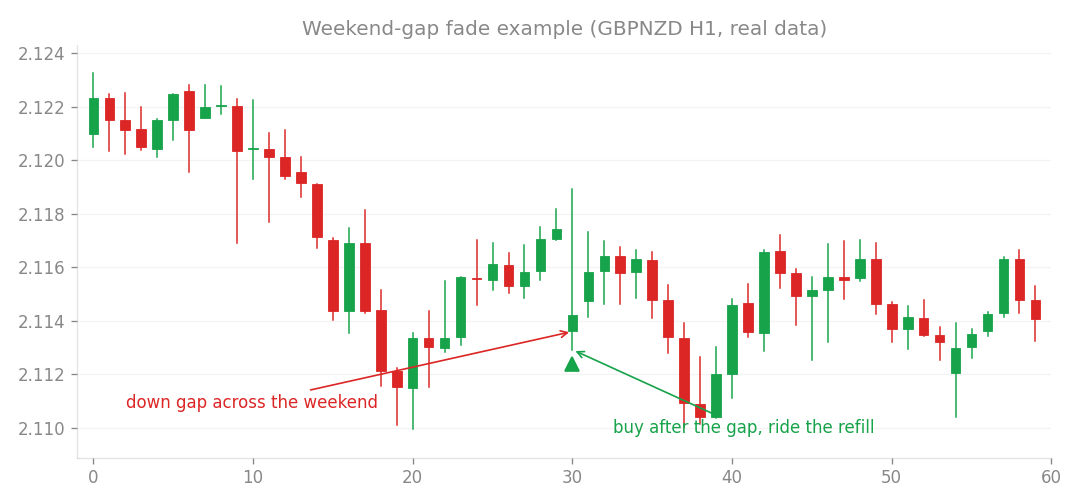
Weekend-gap fade example (GBPNZD H1, real data): trading the refill of a down gap across the weekend.
My research into the “Turn of the Month” (ToM) H1 strategy has reached a final conclusion: I am rejecting it. While the initial theoretical model looked promising, the reality of trading costs makes this strategy economically non-viable.
The theoretical appeal vs. reality
The strategy focused on a specific window around the turn of the month, holding positions for two to four hours across the last H1 bar of the month and the first two bars of the new month. My initial census-based testing, which assumed standard theoretical costs, showed a profit factor (PF) of 3.11 with a monthly return of 0.231% and a drawdown (DD) of 1.4%. However, the strategy requires entering at exactly 0:00 server time. This coincides precisely with the daily rollover, the moment when market liquidity thins and spreads widen drastically.
| Currency Pair | Normal Spread (pips) | 0:00-0:10 Spread (pips) |
|---|---|---|
| CHFJPY | 2.3 | 7.7-10.2 |
| USDCHF | 0.9 | 2.1-3.5 |
| GBPNZD | 5.4 | 11.6-28.8 |
| In other words, the strategy is designed to execute its entry at the exact moment when spreads are three to five times higher than during the day. Even worse, the 95th percentile (p95) data shows spikes as high as 40 pips, meaning the costs are not just high; they are unpredictable. |
The cost of waiting
I tested a variation where I delayed entry by one hour to allow the spread to normalize, exiting at 3:00. This modification caused the performance to collapse entirely.
- Original theoretical PF: 3.11 (Monthly return +0.231%)
- Delayed entry PF: 0.70 (Monthly return -0.070%) This reveals that the alpha, or the “edge” that generates profit, is entirely concentrated in that first hour immediately following the month boundary. Unlike my research into weekend gaps, where the edge persists after the spread normalizes, the ToM strategy’s alpha and its high-cost window are perfectly overlapped. The cost simply eats the profit.
Final verdict
When I applied realistic costs, accounting for the spread multiplier and expected slippage, the strategy’s performance dropped to a PF of 1.05 with a monthly return of 0.012% and a DD of 6.4%. Effectively, the strategy breaks even. This closes my investigation into this specific family of “boundary liquidity” strategies. Of the 13 candidates identified, only the weekend gap strategy (wgap) remains as a viable option, as it is the only one where the alpha survives outside of the high-cost window. The ToM strategy, along with the W1-series, has been rejected due to insufficient results or excessive costs. While one could theoretically attempt to use limit orders to avoid paying the spread, the combination of MT5 stop-level constraints and the extreme tail risk of the spread spikes makes this a low-priority path that is unlikely to yield results.
How this connects
This verification builds on earlier ones (what failed before and what I tried this time, comparisons between approaches).