Shipping the +35% configuration to the live EA, fully audited
The implementation of Configuration D (EA v1.15.0 / Core v1.7.0) is complete, and the new setup has been deployed.
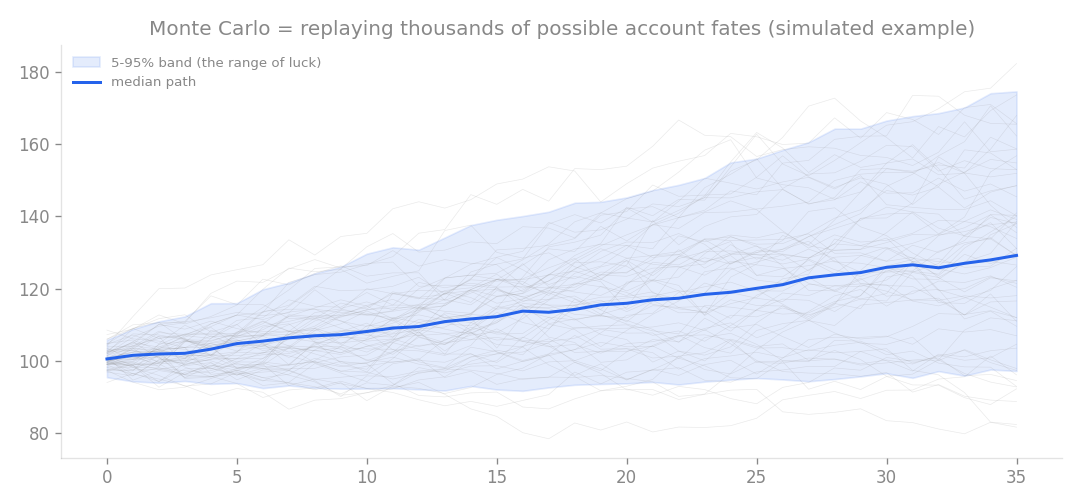
How Monte Carlo works (simulated example): replay thousands of possible account fates and judge the whole range of luck.
The implementation of Configuration D (EA v1.15.0 / Core v1.7.0) is complete, and the new setup has been deployed. This update focuses on integrating the new “Wgap” sleeve while maintaining the existing risk parameters for the three-stage operational pipeline.
M1 Intraday Stress Test
I performed a stress test on the eight sleeves of Configuration D using a conservative synthetic M1 (1-minute timeframe) data set across 8,478 trades. This measurement is crucial for identifying the worst-case intraday loss, which helps ensure the strategy remains resilient during high-volatility events.
- Daily -5% hits: 0
- Maximum -10% hits: 0
- M1 worst loss: -3.43% (observed on May 13, 2019, during a Monday yen surge) In other words, the M1 worst loss worsened by 0.47 percentage points compared to the previous seven-sleeve setup. This was entirely expected due to the increased leverage. The Monday-specific data shows a 95th percentile of -0.85% and a median of -0.09%, confirming that the Wgap cluster remains well within the range of my existing daily flat guard of -4%.
Operational Pipeline Performance
I recalculated the three-stage deployment pipeline using the current presets (KB 2.0 / Cap 2.0). The results indicate a faster path to the first withdrawal compared to previous iterations.
| Metric | Result |
|---|---|
| Days to first withdrawal (median) | 140 days (12% faster) |
| Success rate within 6 months | 44.6% (up from 39.3%) |
| Stress test attainment | 100% |
| While pushing the “Challenge” level to a 3.0 coefficient could shorten the time to first withdrawal to 126 days, I have decided to keep the current presets as they are. Adjusting risk levels is a choice best left to the user, and the current configuration remains robust. |
Steady Withdrawal Optimization
I ran a sweep of the steady withdrawal settings (C × kcap) to see if the current preset (C=15% × KB 2.0 / Kcap 2.5) remains optimal under the constraint of keeping “both” risks at or below 4%.
- Monthly withdrawal rate: Increased from 1.815% to 1.923% (+6%).
- Failure rate: Improved from 2.9% to 2.6%. The system continues to perform optimally without needing to change the K settings for any of the stages. The risk management is effectively handled by the sleeves within Configuration D.
Implementation and Deployment Notes
- EA v1.15.0: The new “SleeveWgap” (H1 timeframe, 10 symbols) is now active. It triggers when the lower gap is >0.5 ATR and >=15 pips, with a default SL of 2 ATR.
- Core v1.7.0: Includes the new Wgap stream. It is backward compatible with v1.6.0 if Wgap risk is set to 0.
- Important: After restarting the EA, the Wgap sleeve will activate immediately with default settings. However, to fully apply Configuration D, you must manually reload the presets to overwrite any existing risk values saved in your charts. I will continue to monitor the spread telemetry via the new CoreV14_spreads.csv log to calibrate the Wgap logic and track the forward performance of the Wgap sleeve against my 2021 edge estimates. Configuration D is now fully deployed and ready for operation.
How this connects
This verification builds on earlier ones (what failed before and what I tried this time, comparisons between approaches).