Searching every sleeve mix ended at +35% monthly returns
Optimizing the current EA portfolio by adding the "wgap" component, halving the weight of "sat2," and applying a global 1.18x leverage multiplier…
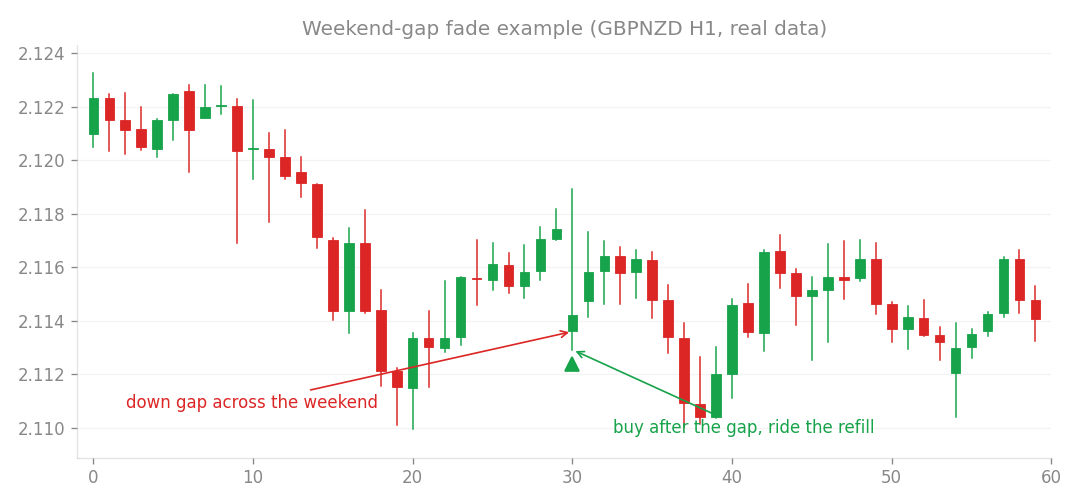
Weekend-gap fade example (GBPNZD H1, real data): trading the refill of a down gap across the weekend.
Optimizing the current EA portfolio by adding the “wgap” component, halving the weight of “sat2,” and applying a global 1.18x leverage multiplier yields the most effective and implementable configuration. This setup achieves a monthly return of +1.060% with a Profit Factor (PF) of 1.69 and a drawdown (DD) of -8.3%, representing a 35% increase in monthly returns compared to the current system while maintaining identical risk levels.
Performance Comparison of Portfolio Configurations
| Configuration | PF | Monthly Return | DD | MC Pass Rate |
|---|---|---|---|---|
| Current Core v1.6.0 | 1.57 | +0.788% | -8.39% | 54.2% |
| Current + wgap (r0.5%) | 1.73 | +1.028% | -8.44% | 71.9% |
| Optimized (D) | 1.69 | +1.060% | -8.33% | 75.3% |
| Note: MC pass rate refers to the probability of passing prop-firm capital rules, calculated via resampling daily returns. |
Analysis of Portfolio Components
The addition of the wgap component is the primary driver of performance, contributing +0.19 percentage points to the monthly return. Conversely, the “sat2” component presents a complex case. While it provides a decent individual monthly return of 0.40%, its contribution to total drawdown is disproportionately high. In other words, halving the weight of sat2 significantly improves the portfolio’s risk-adjusted profile; this finding aligns with previous observations of OOS (out-of-sample) decay. I also tested a more aggressive approach using custom weight optimization. While this produced higher returns during the IS (in-sample) period, the OOS performance gain was negligible compared to the complexity added. Furthermore, the aggressive weightings required for certain components (such as Connors) led to a maximum of 11 simultaneous positions. This violates the 3% open-position limit imposed by the prop firm. Consequently, I have rejected these extreme re-weighting strategies to ensure the system remains robust and compliant with platform constraints.
Verdict and Next Steps
Configuration D is the superior choice for deployment, having demonstrated profitability in all 11 years between 2016 and 2026. Before moving to live execution, I need to finalize the remaining tasks from my separate research track: broker-specific spread calibration, M1 intraday stress testing, and final position cap verification. For those looking for a simpler immediate improvement without the full wgap integration, simply halving the sat2 weight and applying a 1.09x leverage multiplier yields a +0.09 percentage point increase in monthly returns at the same drawdown level. Future work will focus on integrating these changes into the three-stage operational pipeline and further simplifying the EA by potentially phasing out neutral components like Connors_ls and Cal.
How this connects
This verification builds on earlier ones (what failed before and what I tried this time, comparisons between approaches).
- Chasing 3% a month means a 70% drawdown, and every smart…
- Connors RSI2: the first mean reversion that truly added returns
- Hunting regime-proof logic: exactly one candidate passed
- Recomputing the path from pass to payout: 32% faster
- Our PF 4.17 star sleeve was just beta in disguise
- After 200 attempts, is anything still statistically real?
- Weekend-gap fades alone added 30% to monthly returns