That VWAP scalping video re-heats ideas we already tested
I recently reviewed a popular video proposing a scalping strategy for the Nasdaq (NQ) on a 2-minute timeframe, which uses VWAP (Volume Weighted…
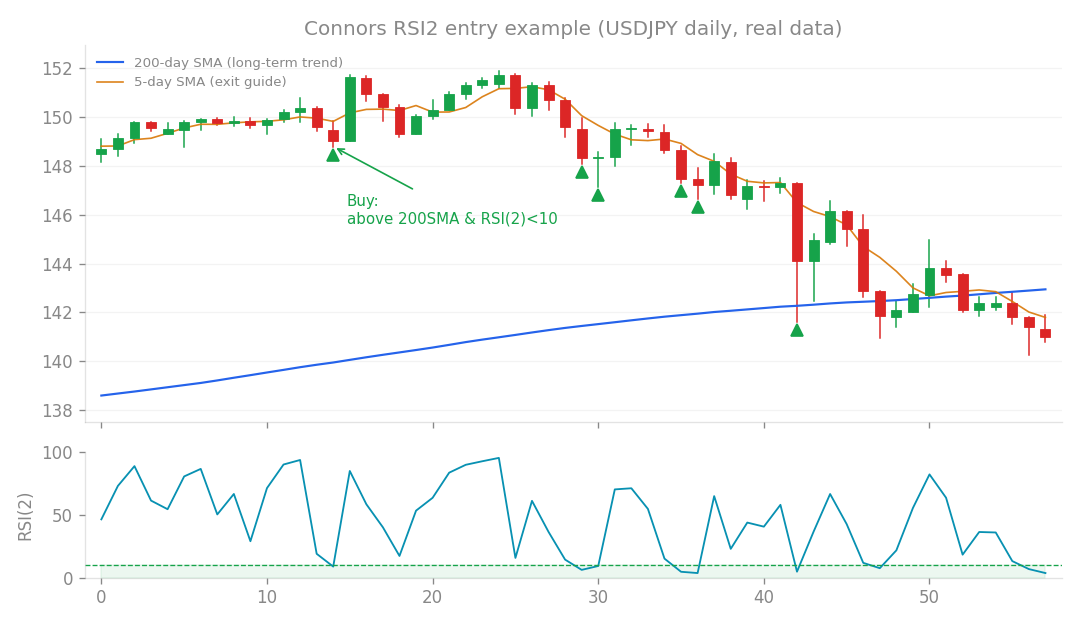
Connors RSI2 entry example (USDJPY daily, real data): buy the dip when price is above the 200-day SMA and RSI(2) falls below 10.
Evaluating the VWAP and DVA Scalping Strategy
I recently reviewed a popular video proposing a scalping strategy for the Nasdaq (NQ) on a 2-minute timeframe, which uses VWAP (Volume Weighted Average Price) and DVA (Developing Value Area) to distinguish between trending and ranging markets. While the concept of switching between mean reversion and trend-following based on price bands sounds intuitive, my analysis suggests it does not meet the requirements for a robust, automated trading system. The strategy relies on two main components, both of which fall short under technical scrutiny:
- The Mean Reversion Core: The strategy uses VWAP-based mean reversion when the market is in a “rotational” (range) phase. I have already tested this logic in a previous research track (Study 132). While that model achieved a PF (profit factor = gross profit / gross loss) of 1.63 and a Sharpe ratio of 0.96, it showed a high correlation of 0.52 with my existing Connors-based strategy. In other words, adding this VWAP logic provided no new edge because it was redundant.
- The VWAP/DVA Execution: The strategy depends on intraday session data and volume, which my current infrastructure cannot support reliably. My index data (US100, US500, US30) is based on daily bars. While I use synthetic intraday reconstructions for stress testing, I do not have access to the true 2-minute tick volume required for accurate VWAP calculations. Furthermore, using tick volume from FX pairs as a proxy for index volume is technically inappropriate. Beyond these technical hurdles, the strategy lacks the rigorous risk management required for prop firm environments. It relies on subjective price action interpretation rather than clear, mechanical rules and offers no defined stop-loss or drawdown control. My past research (Studies 140 to 144) has consistently shown that intraday mean reversion strategies for FX are decimated once real-world spreads are factored in.
Verdict
I have decided to reject this strategy due to its low utility. The mechanical portions of the logic were already proven redundant in earlier tests, and the unique aspects of the strategy fall outside the scope of my current data and operational requirements. While this strategy is not a fit, the verification process itself was valuable. Being able to extract the rules from the video and quickly compare them against my existing baseline allowed me to discard a non-performing idea with minimal effort. Moving forward, if I ever acquire high-quality 2-minute data with genuine volume, there might be a narrow opportunity to test “anchored” VWAP mean reversion against my current baseline to see if it provides any true independent edge. For now, however, my priority remains on capital scaling rather than adding redundant layers to the existing portfolio.
How this connects
This verification builds on earlier ones (what failed before and what I tried this time, comparisons between approaches).
- An index sleeve broke my 0.47% monthly ceiling, then shorting…
- I tested 12 mechanisms to diversify my EA and rejected every…
- Adapting to the current market is an illusion. Confirmed
- Every when-to-enter idea, tested and exhausted
- The math of 3% a month: more accounts, not more leverage
- Our PF 4.17 star sleeve was just beta in disguise