
A no-leverage stock strategy tops out near 1.5% a month
The current setup for my stock swing mean-reversion strategy is hitting a hard ceiling at a monthly return of approximately 1.3%.
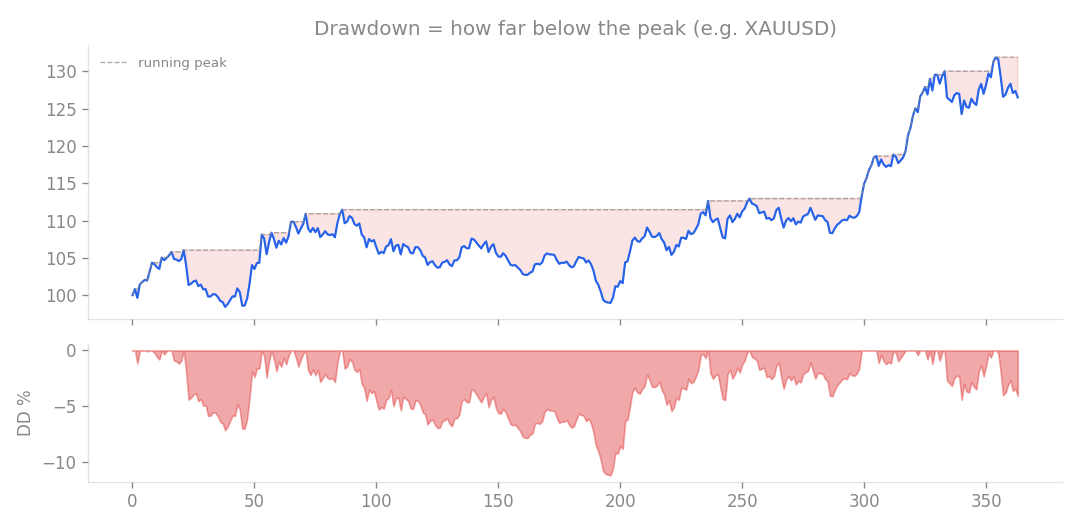
Drawdown = how far the account falls below its running peak (e.g. XAUUSD). The depth of this valley is what risk feels like.
The current setup for my stock swing mean-reversion strategy is hitting a hard ceiling at a monthly return of approximately 1.3%. While it is tempting to try and squeeze out more performance by relaxing entry thresholds, my testing shows that the gains from increased trade frequency are almost perfectly canceled out by the dilution of trade quality.
The constraint is signal scarcity
The strategy currently yields a monthly return of 1.05%, but it only utilizes 25% of the available capital. The primary constraint here is not the position size limit but the rarity of the signals. Specifically, the condition of RSI2 below 10 combined with price being above the 200-day simple moving average (SMA) rarely triggers. I tested this over a 21-year period using 1x leverage, and the results of various adjustments are summarized below.
| Configuration | Monthly Return | PF | Drawdown |
|---|---|---|---|
| Baseline (RSI < 10) | +1.05% | - | - |
| Relaxed (RSI < 20) | +1.32% | 1.40 | -44.0% |
| Optimized (thr10 × f20max5) | +1.26% | 1.66 | -27.7% |
Why relaxing thresholds fails
When I relaxed the RSI threshold from 10 to 15 or 20, the capital utilization increased from 25% to 45%. However, the quality of each trade dropped significantly. The average profit per trade fell from 78.8 basis points to 54.6 basis points, and the drawdown worsened from 24% to 44%. In other words, you are working much harder for very little extra gain while exposing yourself to significantly more risk. The edge simply thins out as you move further from the core signal, so I have rejected the idea of relaxing these thresholds.
Managing idle capital
Since 70% to 75% of the capital remains idle, I looked into ways to put that cash to work without destroying the risk-adjusted returns. Investing that idle cash into indices like SPY or QQQ resulted in monthly returns of 1.66% and 1.96% respectively, but the drawdowns ballooned to nearly 50%. This is too much volatility for my taste. Instead, allocating that idle capital to short-term government bonds (assuming a 4% yield) provides a much cleaner profile. This brings the effective monthly return to approximately 1.50% with a PF of 1.37 and a manageable drawdown of 22.78%.
Final verdict
I am updating the strategy to the thr10 × f20max5 configuration, which uses a -2% limit order and an SMA5 exit. This delivers a 1.26% monthly return with a PF of 1.66. When paired with short-term bond yields for the idle cash, the effective return reaches about 1.5% per month. This approach achieves an annual return of 16% to 20% over a 21-year period that includes the Global Financial Crisis. It serves as a solid, low-correlation addition to my portfolio that is distinct from my FX-based research tracks. Any performance beyond this level would require moving into margin trading or additional capital; this remains a decision for the individual investor.
How this connects
This verification builds on earlier ones (what failed before and what I tried this time, comparisons between approaches).