
In stocks, only buying weakness works. Buying strength loses to random
When moving from day trading to swing trading in stocks, the structural advantages become clear.
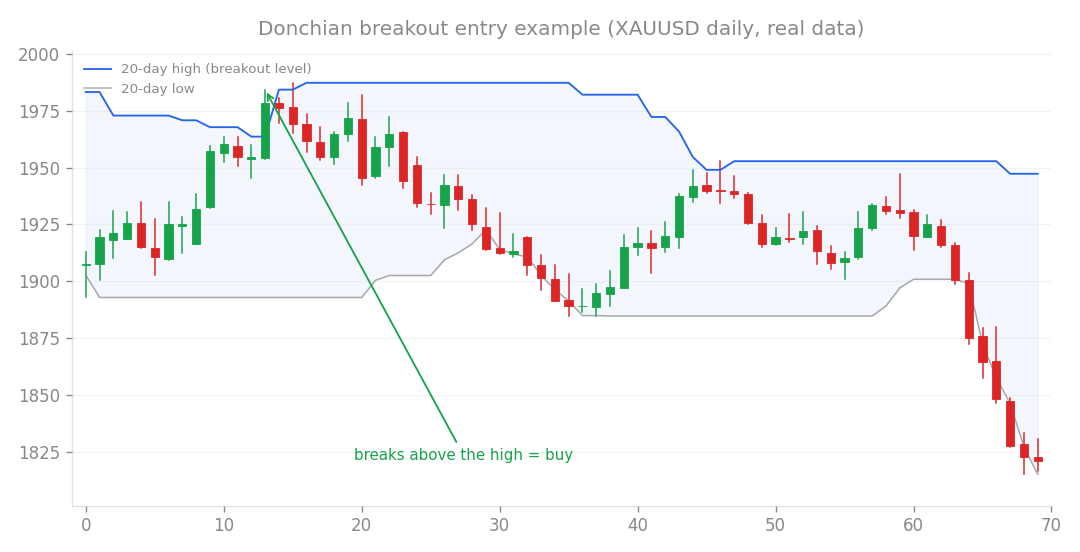
Breakout entry example (XAUUSD daily, real data): buy when price breaks above the recent high.
When moving from day trading to swing trading in stocks, the structural advantages become clear. Unlike day trading, where transaction costs like the 2-cent plus 2-basis point spread eat into your profits, holding positions for several days allows those costs to be amortized. Furthermore, you can capture the overnight drift, which is the price movement that occurs between the close and the next day’s open. To test this, I analyzed 104 tickers on daily charts from July 2024 to June 2026 and 99 tickers on weekly charts from June 2019 to June 2026. This timeframe includes the COVID market crash and the 2022 bear market, providing a look at how strategies hold up across multiple regimes. I tested 20 daily hypotheses and 7 weekly hypotheses, ranging from RSI-based mean reversion to momentum and breakout strategies.
The Randomization Test
The core of this research was comparing these strategies against a “null hypothesis.” Because equity markets have a long-term upward bias, many strategies can appear profitable simply by riding the market beta. To see if my timing signals actually added value, I compared them against 200 random entry models that held the same assets for the same duration. The results were starkly divided:
| Strategy Category | Timing Value | Performance vs. Random |
|---|---|---|
| Mean Reversion (Buying Weakness) | Positive | Excess returns of +4.4 to +164.2 bp |
| Momentum / Breakout (Buying Strength) | Negative | Excess returns of -31 to -169 bp |
| In other words, mean reversion strategies showed a genuine edge. In 15 out of 16 tested cells, these strategies outperformed random entry. However, the effect size is modest, typically adding 15 to 165 basis points per trade. | ||
| Conversely, momentum and breakout strategies were effectively “buying high” and paying a premium for it. Even when the raw returns were positive, they were consistently worse than a random entry in the same market. This is a significant structural difference from FX, where breakout strategies are often a primary driver of success. |
Key Findings and Verdict
My best-performing strategy in the test was an RSI-based approach (RSI < 10, above the 200-day SMA, exiting on a 5-day SMA recovery). In out-of-sample (OOS) testing, which relies on data not used during the strategy creation, it achieved a Profit Factor (PF) of 1.66 with a monthly return of +2.14%. The PF is the ratio of gross profit to gross loss, where anything over 1.0 indicates a profitable system. Despite these positive numbers, I am not adopting this for live trading. The technical timing value in stock swing trading is restricted to buying short-term weakness and exiting within a few days. While the direction is consistent, the edge is quite slim. I will continue to focus my efforts on FX, metals, and index derivatives where the market structure better supports my current systems. For future research, I see three potential paths:
- Re-examining multiple regimes using long-term daily panels from TradingView.
- Attempting to neutralize the market bias by building pairs, such as going long on weak stocks while shorting strong ones.
- Exploring non-price events like earnings, though these remain outside my current scope.
How this connects
This verification builds on earlier ones (what failed before and what I tried this time, comparisons between approaches).