
Why a once-a-decade shock hitting everything at once costs -3.2%
The risk of being disqualified from a prop firm due to sudden market volatility during news events is essentially non-existent with my current EA…
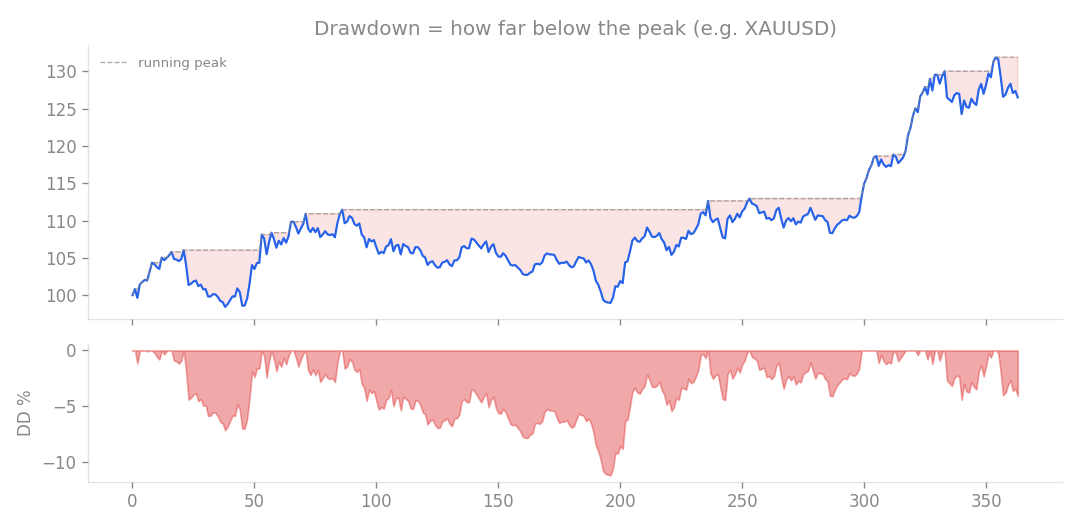
Drawdown = how far the account falls below its running peak (e.g. XAUUSD). The depth of this valley is what risk feels like.
The risk of being disqualified from a prop firm due to sudden market volatility during news events is essentially non-existent with my current EA structure. After running extensive stress tests, I have confirmed that even in the most extreme historical scenarios, the system stays well within the safety margins.
The defensive setup
To protect the account, I use a multi-layered static defense system:
- Server-side Stop Loss (SL) for every open position.
- A total risk cap of 2.5% across all open positions (InpMaxOpenRisk).
- A daily kill-switch, checked every 15 seconds, that halts new trades at -3% and closes all positions at -4%.
- Dynamic position sizing that automatically scales down as the account equity approaches the floor.
In this setup, the only way to suffer a catastrophic loss is through “slippage,” where the market gaps past the SL. The loss in such a scenario is calculated as
Risk × (1 + f), wherefrepresents the gap width relative to the SL distance.
Stress testing against history
I tested this against 11.5 years of 1-minute (M1) data across 15 different asset and side combinations. To ensure accuracy, I carefully filtered out data gaps (such as a missing month of USDCAD data in 2019) that could create “fake” slippage events. When looking at regular scheduled news releases, the slippage factor is negligible. Even at the 99.99th percentile, the slippage is only 0.047, which means the extra loss on a full position is roughly 0.1%. In other words, standard economic indicators do not even come close to triggering a disqualification. I also stress-tested the system against historical market shocks:
- GBP Flash Crash (2016): f = 1.44
- China Black Monday (2015): f = 1.12
- Brexit Vote (2016): f = 0.83
- BOC Surprise Rate Hike (2017): f = 0.73 Even if a major event like Brexit occurred, the average slippage across all assets is 0.29. If I had a full 2.5% risk exposure, the worst-case instantaneous loss would be 2.5% × 1.29, or 3.21%. Since 3.21% is less than the 5% limit, the account remains safe.
Real-world performance
Even when looking at actual historical events, the performance holds up. During the 2020 COVID crash, the worst intraday loss was 2.96%. Other major events, such as the U.S. Presidential Election or the VIX shock, resulted in losses between 2.13% and 2.53%. All of these stayed within the 3% threshold, and not a single day in the last 11 years hit the 5% disqualification limit. My conclusion is that no code changes are necessary. The only remaining risk is a highly improbable “compound tail event,” where all positions simultaneously gap more than 40% past their SL in the 15-second window following a -4% trigger. This is already accounted for in my Monte Carlo (MC) pass rate, which represents the probability of failing prop firm rules due to resampling daily returns and sits at a very low 0.5% to 0.9%. The system is robust.
How this connects
This verification builds on earlier ones (what failed before and what I tried this time, comparisons between approaches).