
Of every false-breakout fix, only volume confirmation survived
Adding a volume expansion filter is the only remaining method that improves the quality of my breakout strategy, though I am holding off on…
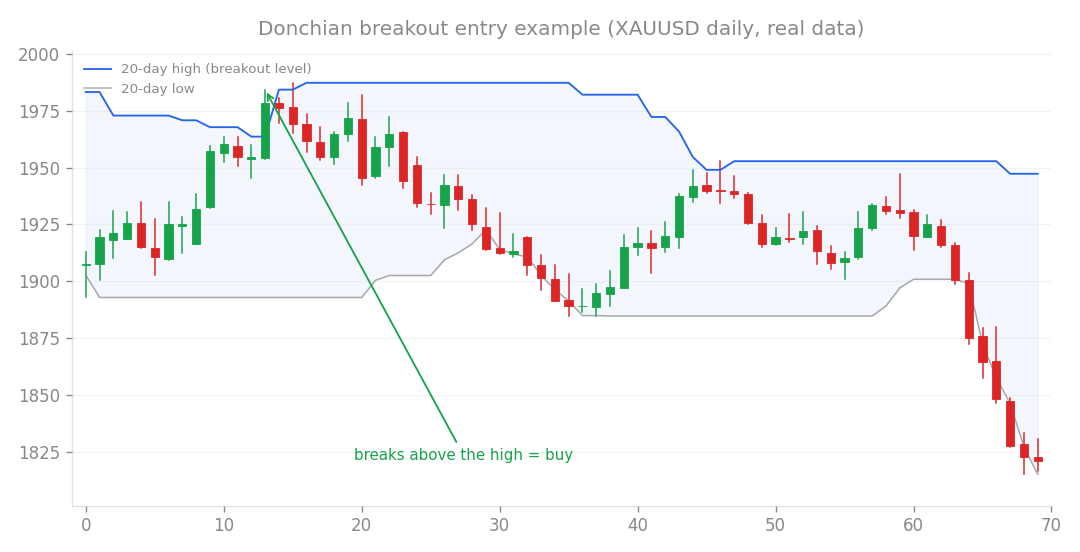
Breakout entry example (XAUUSD daily, real data): buy when price breaks above the recent high.
Adding a volume expansion filter is the only remaining method that improves the quality of my breakout strategy, though I am holding off on integrating it into my live account for now. For a long time, I have been testing different ways to filter out “fake breakouts”: those moments where price moves past a level only to snap back immediately. My previous research into ADX, RSI, volatility metrics like Hurst, and even bar-counting methods like NR7 all failed to provide a meaningful edge. This left me with three final areas to test: volume expansion on the breakout bar, session-based filtering, and time-based exits. I ran these through a comparative test, measuring them against my core FX breakout strategy.
| Method | PF (Profit Factor) | Monthly Return | DD (Drawdown) | Sharpe Ratio |
|---|---|---|---|---|
| Baseline | 1.27 | +0.149% | -6.5% | 0.53 |
| Volume 1.2x | 1.30 | +0.140% | -6.0% | 0.58 |
| Session (9-22) | 1.29 | - | - | - |
| Time-Stop | 1.15 to 1.21 | - | - | - |
| In other words, the Profit Factor (the ratio of gross profit to gross loss) improved when I required the breakout bar to have 1.2 times the recent average volume. While the monthly return dropped slightly, the quality of the trades increased, as shown by the better Sharpe ratio and lower drawdown. The “Time-Stop” method was a clear failure, leading to frequent re-entries and a 55% increase in trade count that diluted performance. Interestingly, the volume filter only worked for my core FX pairs. When applied to indices, the PF plummeted from 5.52 to 3.78, proving that this is a niche tool rather than a universal rule. | ||||
| I then integrated the volume filter into my established v1.5.0 configuration to see how it affected the system as a whole, using a Monte Carlo simulation of 20,000 runs to gauge the probability of passing prop-firm style rules. | ||||
| Metric | v1.5.0 (Baseline) | v1.5.0 + Volume 1.5x | ||
| :— | :— | :— | ||
| PF | 1.64 | 1.66 | ||
| Monthly Return | +0.814% | +0.801% | ||
| DD | -8.4% | -8.1% | ||
| MC Pass Rate | 96.9% | 97.4% | ||
| Disqualification Rate | 0.9% | 0.5% | ||
| The results show a genuine improvement. The disqualification rate was halved and the drawdown improved by 0.3 percentage points. However, the gains are quite small. | ||||
| Because I am currently running a live challenge on Fintokei, the risk of introducing a change that might behave differently due to broker-specific tick volume distributions is not worth the minor performance boost. I have decided to keep the volume filter as a candidate for the v1.6/EA v1.10 update cycle rather than applying it now. For those interested in replicating this, it can be implemented in MT5 using the iVolume indicator to compare the breakout bar against the relative average. |
How this connects
This verification builds on earlier ones (what failed before and what I tried this time, comparisons between approaches).