Hunting regime-proof logic: exactly one candidate passed
Searching for a trading logic that remains profitable regardless of market regime or the overall trend is a difficult task.
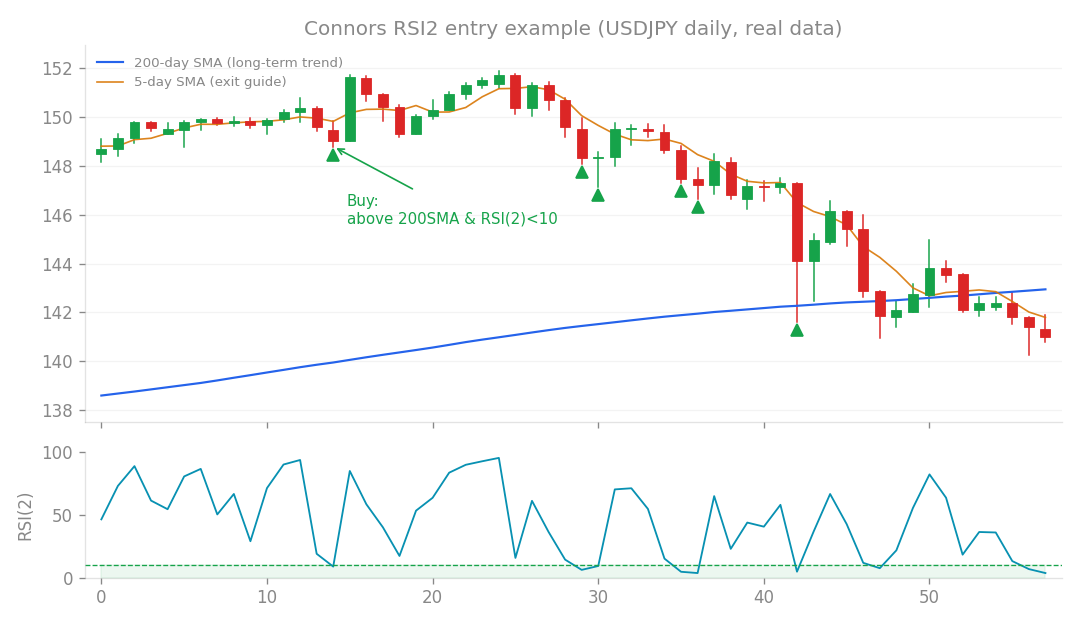
Connors RSI2 entry example (USDJPY daily, real data): buy the dip when price is above the 200-day SMA and RSI(2) falls below 10.
Searching for a trading logic that remains profitable regardless of market regime or the overall trend is a difficult task. To find one, I established strict passing criteria: the strategy must be profitable in both yen-weak (USDJPY > SMA200) and yen-strong periods, and it must maintain a profit factor (PF), defined as the ratio of gross profit to gross loss, greater than 1.0 in both in-sample (2015 to mid-2020) and out-of-sample (late 2020 to present) periods, all while accounting for trading costs.
Testing cross-section reversal and Connors-LS strategies
I evaluated two primary approaches. First, I tested a cross-section reversal strategy, which uses a basket of assets to remain directionally neutral. Every one of the eight variants failed. In other words, even when the structure is designed to be neutral, the source of the return remains conditional on the market environment. I observed that the returns frequently flipped signs between yen-weak and yen-strong periods. For instance, one JPY6 variant returned +0.155% in a strong-yen environment but lost 0.250% when the yen was weak. In contrast, the USD-quoted Connors-LS strategy, a mean-reversion approach, yielded a different result.
| Metric | Performance |
|---|---|
| Trade Profit Factor | 1.24 |
| Monthly Return | +0.066% |
| Maximum Drawdown | -3.61% |
| In-Sample PF | 1.096 |
| Out-of-Sample PF | 1.140 |
| Yen-Weak Period PF | 1.094 |
| Yen-Strong Period PF | 1.148 |
| The USD-quoted version was the only candidate to pass all four segments of my criteria using fixed parameters. The JPY-cross version failed, showing a trade PF of 1.03 and an in-sample return of -0.116% during yen-weak periods. |
Verdict: The reality of regime-neutral edges
The USD-quoted Connors-LS logic is the only candidate that formally passed these tests. However, it is important to manage expectations regarding its scale. Its monthly return of 0.066% is roughly one-tenth the size of my core trend-following systems. Furthermore, its Monte Carlo pass rate (the probability of surviving various market conditions) is only 8.3%, meaning it cannot be operated as a standalone system. This reveals a fundamental structure of this asset universe: the larger edges are tied to directional trends or regime betas. When you strip away that dependency to create a regime-neutral strategy, you are left with only the smaller, mean-reverting edges. The optimal path forward is to maintain my current design, which relies on a large trend-following core balanced by defensive, regime-neutral components. Based on these results, I am prioritizing the integration of the USD-quoted Connors-LS short paths into the MT5 workflow. This serves as a functional insurance policy against a shift toward a stronger yen. While the strategy is technically sound, I remain cautious; previous rolling-window tests showed a win rate of only 4 out of 8, so I will continue to monitor its performance closely in live forward testing.
How this connects
This verification builds on earlier ones (what failed before and what I tried this time, comparisons between approaches).