
How much does the minimum lot size hurt a small account?
My latest research confirms that using a 0.01 minimum lot size on a 1 million JPY account causes a 56% reduction in trade frequency, yet the impact…
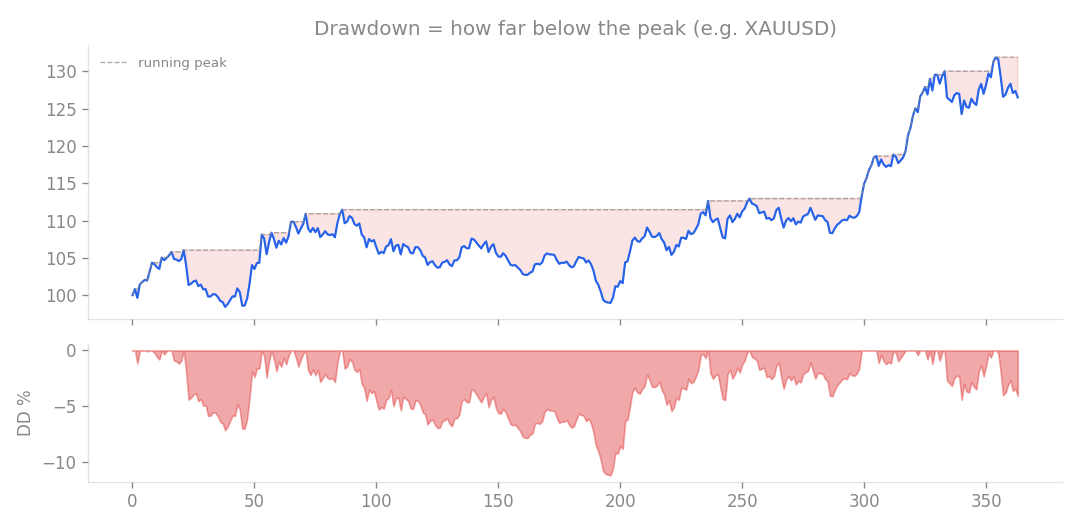
Drawdown = how far the account falls below its running peak (e.g. XAUUSD). The depth of this valley is what risk feels like.
My latest research confirms that using a 0.01 minimum lot size on a 1 million JPY account causes a 56% reduction in trade frequency, yet the impact on overall performance is surprisingly minor. The root of this issue lies in how we model our trades. In my Python backtesting, I have traditionally assumed fractional lots, which allows for precise risk management. However, real-world EAs (Expert Advisors) operate under stricter rules. When an EA calculates that a trade requires less than the minimum lot size (0.01), it simply skips the trade to avoid over-leveraging. To bridge this gap, I created a new configuration tool that simulates the exact constraints of a broker, accounting for minimum lots and currency conversion from JPY to the quote currency.
Performance comparison by account size
When I applied these realistic constraints to the EA using its most conservative settings (risk factor k=1), the results showed how the “missing” trades impact the bottom line.
| Account Balance | PF | Monthly Return | Drawdown | Trade Retention |
|---|---|---|---|---|
| 1,000,000 JPY | 1.81 | +0.712% | -6.78% | 44% |
| 2,000,000 JPY | 1.70 | +0.620% | -6.78% | 63% |
| 3,000,000 JPY | 1.65 | +0.624% | -8.24% | 82% |
| 5,000,000 JPY | 1.60 | +0.607% | -8.30% | 93% |
| 10,000,000 JPY | 1.57 | +0.599% | -8.36% | 98% |
| (For reference, the baseline with fractional lots yielded a PF of 1.64, a monthly return of +0.814%, and a DD of -8.36%.) |
Analyzing the “skipped” trades
On a 1 million JPY account, the skip rate is significant. Specifically, Gold (XAU/USD) trades dropped from 1,661 down to 503, with H4 and D1 timeframes being almost entirely eliminated. Similarly, USD-based Connors-style trades (like AUD/USD or GBP/USD) vanished completely. Conversely, index and cross-pair Connors trades remained largely untouched because their contract sizes or stop-loss structures naturally require larger lot sizes, keeping them above the 0.01 threshold.
Verdict
While the EA is technically “missing out” on trades, this acts as a natural filter that removes small-size trades with wide stop-losses. This actually improves the Profit Factor (PF) and reduces the absolute drawdown on smaller accounts. In other words, the skip is not a fatal flaw. Increasing the dynamic leverage (the k-factor) allows for larger lot sizes, which reduces the skip rate. A k-factor of 2.5 effectively brings a 1 million JPY account to the performance level of a 3 million JPY account. Consequently, the effect on my previously planned withdrawal schedule is minimal, likely resulting in a delay of only 10% to 20% at most. For those running accounts of 3 million JPY or more, this discrepancy effectively disappears. I recommend monitoring your own EA’s trace logs to compare these simulated skips against actual forward execution.
How this connects
This verification builds on earlier ones (what failed before and what I tried this time, comparisons between approaches).