Taking profit at higher-timeframe levels: worse or equal, never better
Adding profit-taking rules based on higher timeframe support and resistance levels does not improve overall performance.
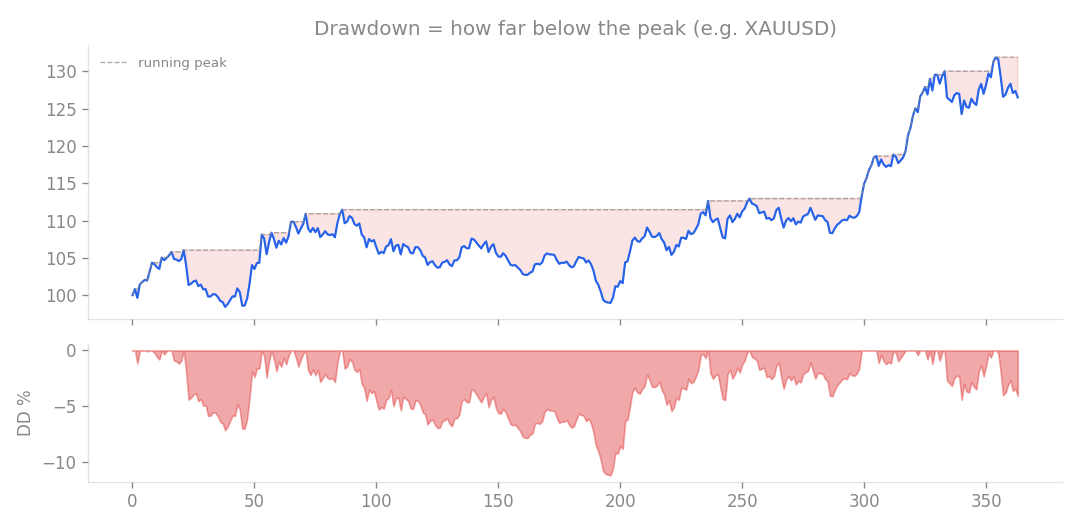
Drawdown = how far the account falls below its running peak (e.g. XAUUSD). The depth of this valley is what risk feels like.
Adding profit-taking rules based on higher timeframe support and resistance levels does not improve overall performance. My latest research into using higher timeframe zones to protect open profits resulted in either a significant degradation of returns or at best a negligible reduction in risk.
The hypothesis
I tested whether closing trades when price hits a strong level on a higher timeframe (like a daily chart for an H1 strategy) could preserve profits that would otherwise be given back during a pullback. I used a script to calculate level importance based on touch frequency and reaction strength, ensuring no data leakage by referencing only closed bars. I applied this to my core trend-following strategy with a risk of 0.003 (0.3% per trade).
Comparison of exit strategies
I compared the baseline performance against two variations: “touch” (closing immediately upon hitting the zone) and “bounce” (closing only after price hits the zone and shows a confirmed reversal).
| Strategy | PF | Monthly Return | Max DD | Sharpe |
|---|---|---|---|---|
| Baseline | 1.51 | +0.401% | -5.29% | 0.27 |
| Touch (Score 10) | 1.37 | +0.324% | -5.35% | 0.22 |
| Bounce (Score 5) | 1.47 | +0.399% | -4.46% | 0.27 |
| PF = Profit Factor (gross profit / gross loss; >1 is profitable). DD = Drawdown (peak-to-trough decline). |
Analysis of the results
The “touch” method was a clear failure. While it significantly increased the win rate to 71%, the Profit Factor collapsed. This is a classic example of the “win rate trap,” where the strategy cuts off the long tail of large, profitable trades that drive the overall performance. In other words, by trying to capture profits early, I was effectively sabotaging the strategy’s ability to capitalize on major trends. The “bounce” method performed similarly to the baseline. It provided a minor reduction in drawdown (about 16% lower than the baseline), but it failed to improve the monthly return or the Sharpe ratio. The results were consistent across both the in-sample and out-of-sample periods, but the benefits were too small to justify the added complexity.
Conclusion
I am rejecting this approach for my core systems. The results align perfectly with my previous exit research: trend-following profits rely heavily on the “tail” of big wins, and any form of early profit-taking tends to erode those gains. While the “bounce” method offers a slight defensive benefit by reducing drawdown, it does not increase total returns. I will keep the code for these level-based exits as a utility for specific, high-leverage scenarios where I might need a safety valve for intraday risk, but they have no place in my standard trend-following setup.
How this connects
This verification builds on earlier ones (what failed before and what I tried this time, comparisons between approaches).