
Attack harder as the profit cushion grows: verified
The core strategy of building a "cushion" before increasing risk is mathematically sound.
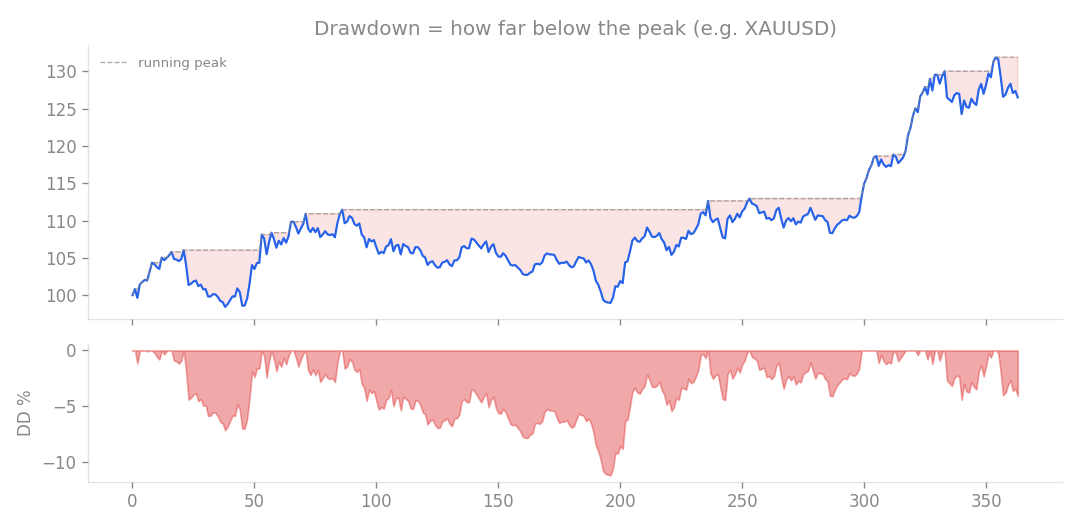
Drawdown = how far the account falls below its running peak (e.g. XAUUSD). The depth of this valley is what risk feels like.
The core strategy of building a “cushion” before increasing risk is mathematically sound. Many prop firm accounts have a 10% maximum drawdown (DD) based on the initial balance. If this floor is static, every dollar you earn above the starting balance acts as a buffer. By keeping a portion of your profits in the account rather than withdrawing them immediately, you essentially move your equity further away from that dangerous floor. I modeled this using a 750-day Monte Carlo (MC) simulation, where the goal was to determine how much risk (k) I could take based on the distance between my current equity and the 90% floor.
Performance comparison: The impact of a 10% cushion
| Strategy | Monthly Return | Total Payout | Failure Rate |
|---|---|---|---|
| No Cushion (C=0) | 0.70% | 25.0% | 0.1% |
| 10% Cushion (C=0.1) | 0.92% | 33.0% | 0.0% |
| Note: PF=1.64 across all models. Failure rates are based on the risk of hitting a 5% daily loss limit. | |||
| In other words, by holding a 10% cushion and dynamically scaling risk, I was able to increase the monthly return by 31% while simultaneously reducing the probability of account failure to zero. |
The dangers of over-leveraging
While scaling risk is effective, there is a hard ceiling. My testing shows that a risk cap (k_cap) of 2.0 is dangerous. At a 10% cushion, using a k_cap of 2.0 resulted in an 18.9% failure rate, driven entirely by the 5% daily loss limit. The root cause is the worst-case single-day loss of 3.22%. When you scale that by 2.0, you hit a 6.44% loss, which triggers a failure. Even with a 20% cushion, that same cap resulted in a 29.8% failure rate. My analysis suggests that a multiplier of 1.5 is the absolute safety limit, as 1.5 times the worst-case daily loss (3.22%) lands you at 4.83%, just shy of the 5% kill switch.
Key constraints and implementation
To make this work, two conditions are mandatory:
- The prop firm’s 10% drawdown must be based on the initial balance (static), not a trailing drawdown.
- You must not withdraw all profits; you must maintain that cushion to keep the drawdown constraint effectively nullified. The constraints that remain are the 5% daily loss limit and a 3% concurrent open-position limit. My research suggests the 3% limit is manageable if the EA is configured to cap total risk across all open trades.
A note of caution
While the “cushion” strategy is viable, the numbers above represent the upper bound of safety. My follow-up audits indicate that if the market conditions shift or if the drawdown is trailing rather than static, the performance drops significantly. Monthly returns fall to 0.33% with a 4.6% failure rate. For real-world application, I recommend lowering the risk cap to 1.2 or 1.3. This provides a necessary margin of safety against intraday volatility, which is often more severe than the end-of-day closing prices used in these models. Always confirm the specific drawdown rules of your provider before deploying this logic.
How this connects
This verification builds on earlier ones (what failed before and what I tried this time, comparisons between approaches).