
The Nampin Trap: Our EA Reveals How Averaging Down Amplifies Losses!
## What's the big idea?
A beginner-friendly summary of the verification: “The Nampin Trap: Our EA Reveals How Averaging Down Amplifies Losses!”.
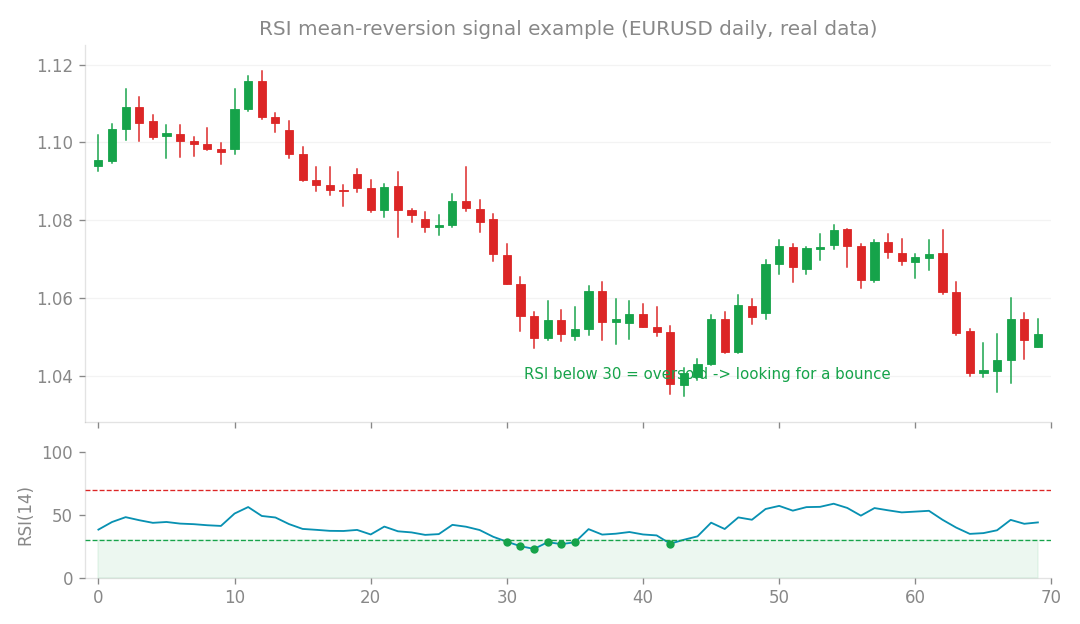
Mean-reversion (RSI) signal example (EURUSD daily, real data): look for a bounce when RSI is oversold.
What’s the big idea?
Today, we’re diving into a trading concept called Nampin, or “averaging down.” You might have heard of it, and it sounds appealing on the surface. The basic idea is this: if you open a trade and the market moves against you, putting you in a floating loss, you open another position in the same direction at the new, worse price. The goal? To lower your overall average entry price. If the market then recovers even slightly, you reach breakeven or profit faster than if you’d just waited for your initial entry price to be hit. It’s the opposite of pyramiding (which we looked at in Research 53), where you add to a winning position. With Nampin, you’re essentially buying more when your trade is already losing, hoping for a bounce. It’s a common strategy, especially among manual traders, but can it work for an Expert Advisor (EA)? Let’s find out!
How I tested it
To test Nampin, I took one of my most reliable core EAs – a robust strategy designed for FX on the H1 timeframe with a sensible stop-loss based on ATR (Average True Range, which is a common way to measure market volatility). This EA is usually quite stable. I then introduced the Nampin logic: if the EA opened a trade and it went into a floating loss by a certain multiple of the ATR, it would add another position. I compared four scenarios:
max_adds = 0: This is my baseline, the original EA with no Nampin at all.max_adds = 1: The EA could add one extra position when in loss.max_adds = 2: The EA could add up to two extra positions.max_adds = 3: The EA could add up to three extra positions. The goal was to see if increasing the number of Nampin layers would actually help mitigate losses or improve overall performance.
What happened? (The Cold, Hard Truth)
Turns out, Nampin didn’t just fail to help; it made things significantly worse. The results were a clear, monotonic deterioration as I increased the max_adds parameter.
Here’s a breakdown of the key metrics:
- Profit Factor (PF): This is a crucial metric that tells you how much gross profit you make for every dollar of gross loss. A PF greater than 1 means you’re profitable.
- Without Nampin (
max_adds=0): PF was a healthy 1.22. - With Nampin (
max_adds=3): PF dropped to a meager 1.11. - In other words: The more Nampin I added, the less efficient the strategy became at generating profit relative to its losses.
- Total Return: This is the overall percentage gain of the strategy.
- Without Nampin: The EA managed a respectable +41% return.
- With Nampin (
max_adds=3): This plummeted to just +28%. - In other words: Nampin significantly reduced the total profit generated by the EA.
- Maximum Drawdown (DD): This is the largest peak-to-trough decline in your account balance, representing the worst possible losing streak. This is where Nampin truly showed its destructive power.
- Without Nampin: The Max DD was a manageable -13.2%.
- With Nampin (
max_adds=3): This figure soared to a terrifying -26.9%! - In other words: Nampin almost doubled the maximum amount of capital lost during a losing period. This is a massive increase in risk for a lower return.
- Daily -5% M1 Breach: Many prop trading firms (companies that give you capital to trade with, under strict rules) have daily loss limits, often around -5%. Breaching this even once can mean immediate disqualification.
- Without Nampin: The EA hit the daily -5% limit only 1 day out of the entire test period.
- With Nampin (
max_adds=3): This jumped to 2-3 days! - In other words: Nampin turned a potentially acceptable strategy for prop firms into an immediate disqualifier. Hitting that limit multiple times is a death sentence for a funded account.
What I learned (Why it’s a Trap)
The conclusion is stark: Nampin does not reduce losses; it hides and amplifies them. Here’s why this strategy is so dangerous:
- The Illusion of Control: Nampin gives the impression of “rescuing” trades. You might see more trades eventually close in profit because the average price was lowered. This makes your apparent win rate look better, but it’s a mirage.
- The Martingale Trap: This strategy shares a fundamental flaw with Martingale-like approaches. While it reduces the frequency of small, manageable losses, it does so at the cost of turning those rare, sustained reversals into catastrophic, account-destroying losses. It’s like trading many small, predictable setbacks for a few unpredictable, gigantic failures. You’re effectively digging a deeper hole for yourself, hoping the market will eventually turn around. What happens when it doesn’t?
- Against Sound Trading Principles: Professional trading often emphasizes cutting losses short and letting profits run. Nampin does the exact opposite: it encourages you to hold onto losing positions longer and add to them, hoping for a recovery. It’s like trying to catch a falling knife – you’re likely to get cut.
- Fatal for Prop Trading: As the daily breach numbers clearly show, Nampin is a non-starter for prop firms. A -27% maximum drawdown would also likely put you over most maximum overall loss limits, leading to immediate account termination. Prop firms prioritize consistent, controlled risk, which Nampin completely undermines.
- No Edge in Trend-Following: My core strategy often seeks to follow trends. Nampin goes against this by attempting to fight a sustained move. If a trend is strong and against your initial entry, adding to that losing position is just throwing good money after bad. This research reinforces a broader point: adding to positions, whether it’s pyramiding (adding to winners, which we found unsuitable in Research 53 for similar risk amplification reasons) or Nampin (adding to losers), introduces significant risk that is generally incompatible with the strict risk management required for prop trading and long-term algorithmic consistency. My stance remains firm: strategies involving Martingale or grid-like averaging down are a definite “no” for robust, sustainable EAs, especially when targeting prop firm consistency rules like those at Fintokei. Avoid Nampin!
How this connects
This verification builds on earlier ones (what failed before and what I tried this time, comparisons between approaches).