
The Take Profit Trap: Why Our EA Found "No TP" is Actually Best!
Sometimes, the simplest approach is the best. Today, we're diving into an experiment that looked at whether adding a fixed Take Profit (TP) could impr
A beginner-friendly summary of the verification: “The Take Profit Trap: Why Our EA Found “No TP” is Actually Best!”.
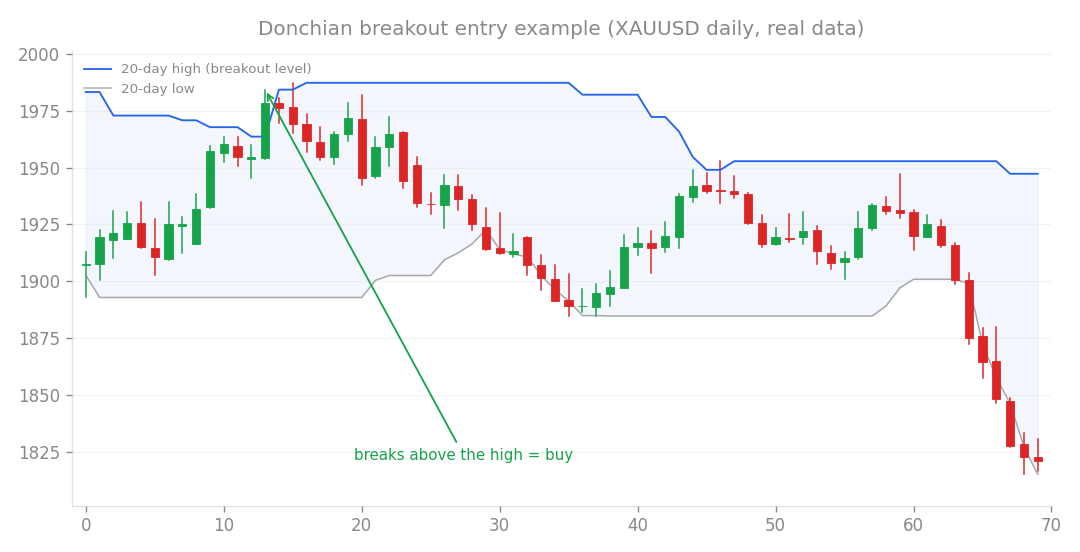
Breakout entry example (XAUUSD daily, real data): buy when price breaks above the recent high.
Sometimes, the simplest approach is the best. Today, we’re diving into an experiment that looked at whether adding a fixed Take Profit (TP) could improve one of our trend-following EAs, “BreakoutLong.” The existing strategy doesn’t use a fixed TP; instead, it closes trades when the price exits a channel. We wanted to see if setting a specific profit target would make it even more robust.
What’s the idea?
A Take Profit (TP) is a pre-set price level where your trade automatically closes to lock in profits. It sounds like a smart move, right? You define your profit goal, and once the market hits it, you’re out. For our “BreakoutLong” strategy, which is designed to catch significant market trends, we wondered if adding a fixed TP could help us secure gains more consistently or improve overall performance. Our hypothesis was that maybe, just maybe, there’s a sweet spot for a fixed TP that could optimize the strategy’s performance, balancing consistent wins with overall profitability.
How I tested it
To test this, we introduced a fixed TP mechanism to the “BreakoutLong” EA. Instead of letting the trade run until it exited its channel, we forced it to close once it hit a specific profit target. We didn’t just pick one TP level; we performed a “sweep,” testing a range of profit targets from 1 ATR all the way up to 12 ATR. ATR, or Average True Range, is a common measure of market volatility, so using multiples of ATR allows us to set TPs that adapt to current market conditions. We also kept the original “no fixed TP” setup as our baseline, where the EA closes trades based on its channel exit logic. The test environment was robust: we ran this across multiple currency pairs (FX) on the H1 (1-hour) timeframe, incorporating Higher Time Frame (HTF) analysis, and using data from 2015 to 2024. This ensures the results are reliable and cover a wide range of market conditions.
What happened?
The results were surprisingly clear and, dare I say, monotonous. There was no “sweet spot” in the middle. Instead, we observed a consistent trend across all metrics: the tighter the Take Profit, the worse the strategy performed overall. Conversely, the “no fixed TP” approach, where profits were allowed to run, consistently delivered the best results across almost every key performance indicator. Let’s break down the numbers:
- Win Rate: When we used a very tight TP (1 ATR), the win rate shot up to an impressive 75.5%! This means nearly three-quarters of trades were profitable. However, with no fixed TP, the win rate dropped significantly to a seemingly low 36.8%.
- Profit Factor (PF): This is where the story changes dramatically. Profit Factor (PF) is calculated as gross profit divided by gross loss; a PF greater than 1 means the strategy is profitable. For the 1 ATR TP, despite the high win rate, the PF was a dismal 0.94. In other words, it was a losing strategy overall! The “no fixed TP” strategy, however, boasted a healthy PF of 1.31.
- Total Return: The impact on overall profitability was stark. A tight 1 ATR TP led to a -26% loss over the testing period. The “no fixed TP” strategy, by contrast, generated a fantastic +122% profit!
- Drawdown (DD): Drawdown (DD) measures the maximum peak-to-trough decline in your equity. Tight TPs made the drawdown much worse, hitting a painful -41.5% at 1 ATR. The “no fixed TP” approach kept it much more manageable at -21.4%.
- Trade Volume: And get this: tight TPs meant a massive increase in the number of trades, jumping from 1166 (no TP) to 4791 (1 ATR). More trades mean higher transaction costs (spreads, commissions) and more exposure to market noise, further eating into profits. In other words, “no fixed TP” (letting the strategy close trades as it naturally would based on its channel exit logic) was superior in every single metric except for win rate.
The “Win Rate Trap”
This experiment perfectly illustrates what we call the “Win Rate Trap.” A strategy with a 75.5% win rate sounds amazing, right? It feels good to win most of the time. But if each win is tiny and each loss is huge, you’ll still lose money overall. That’s exactly what happened here: a high win rate came with a losing Profit Factor of 0.94 and a painful -41.5% drawdown. Trend-following EAs, like our BreakoutLong, are often “low win rate” but “high profit per trade” strategies. They are designed to catch those big, infrequent market moves – what statisticians might call “fat tail” events. Imagine fishing: you might cast your line many times without a bite (low win rate), but when you finally hook a big one, it makes up for all those empty casts and more! If you cut the line too early, you’d never land that prize fish. Using a tight TP is like cutting the line. It ensures you bag many small fish, boosting your win rate, but you completely miss out on the occasional whale that actually drives your profitability. You effectively chop off the “fat tail” of big wins, destroying the strategy’s edge. Tight TPs also force the EA to trade more frequently, leading to higher transaction costs (spreads, commissions) and more exposure to “noise” or false signals, further worsening drawdown.
What I learned
This research strongly confirms that for our BreakoutLong strategy, “letting profits run” – by not using a fixed Take Profit and allowing the channel exit logic to do its job – is the correct approach. The strategy is designed to capture large trends, and arbitrarily capping those profits with a fixed TP is detrimental to its overall performance. This finding aligns perfectly with insights from previous studies (like Research 38 on meta-labels, 57 on exits, and 116 on scale-out techniques), all pointing to the power of letting winning trades develop. It’s a fundamental principle for many trend-following systems. The practical outcome is straightforward: no changes are needed for the current system. This experiment simply reinforces the wisdom of its existing “no fixed TP” design. Sometimes, the best optimization is to trust the strategy’s core logic and let it do what it’s built to do!