
Do Stronger Support/Resistance Lines Mean More Wins? We Tested It!
## What's the idea?
A beginner-friendly summary of the verification: “Do Stronger Support/Resistance Lines Mean More Wins? We Tested It!”.
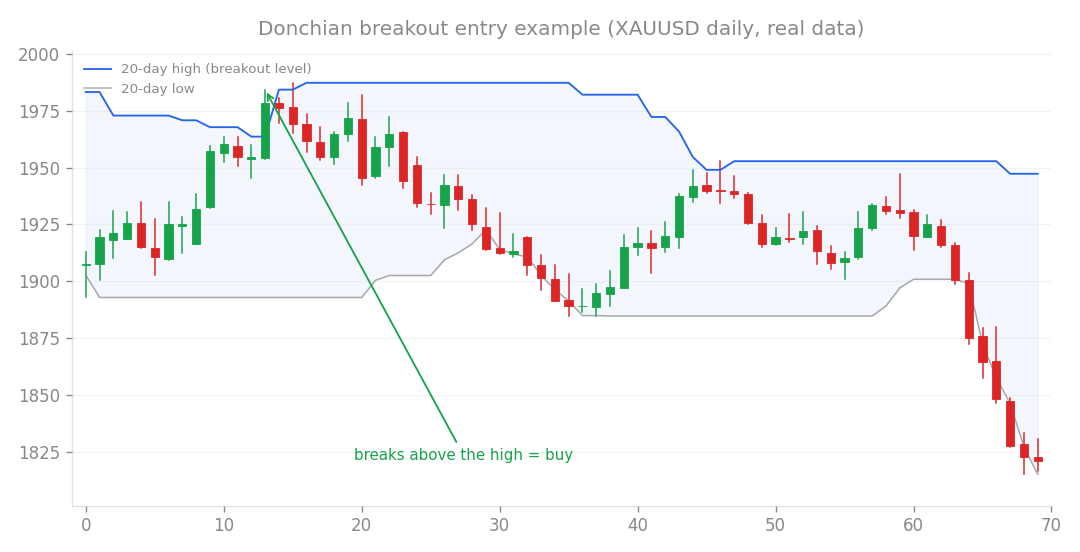
Breakout entry example (XAUUSD daily, real data): buy when price breaks above the recent high.
What’s the idea?
Wouldn’t it be great if we could spot market conditions that almost guarantee higher win rates for our Expert Advisors (EAs)? The thinking goes like this: imagine the market as a landscape with support and resistance levels – those invisible lines where prices tend to bounce or break. Some areas might have many strong, clear levels stacked up, while others are a bit “flatter” or less defined. The user hypothesis we wanted to test was simple: if a market looks “structurally strong” – meaning lots of clear support/resistance levels (what we call “level intensity” or “level strength”) – then our trading strategy should perform better there. And if it performs better, why not increase our risk a bit to capitalize on those supposedly “safer” or higher-probability trades? More strength, more profit, right? We wanted to see if this “strength-linked sizing” strategy made sense.
How I tested it
To put this to the test, I took a deep dive into historical trade data from two different Expert Advisors (EAs). For each trade, I calculated a “level strength score” at the exact moment of entry. This is important: no looking back with hindsight! This score basically tells us how many significant support or resistance levels were active around the entry point, giving us a measure of market “structure” or “intensity.” Then, I grouped these trades into four “quartiles” based on their level strength – from the weakest 25% (Q1) to the strongest 25% (Q4). For each quartile, I crunched the numbers on three key performance indicators:
- Win Rate: The percentage of trades that made a profit.
- Profit Factor (PF): This is a super important metric! It’s calculated as your gross profit divided by your gross loss. A PF greater than 1 means your strategy is profitable overall. For example, a PF of 1.5 means for every $1 you lose, you’re making $1.50.
- Average R: Essentially, your average risk-reward ratio per trade. A higher R means you’re generally making more on your winning trades compared to what you risk.
What happened?
Let’s break down the results for each strategy.
Strategy A: The Trend Break EA
First up was an EA designed to trade trend breakouts (specifically, a robust strategy on FX H1 timeframe, looking at 1898 trades). This strategy aims to catch a move after price breaks through a significant level. The results were pretty clear: there was virtually no monotonic relationship between level strength and performance. “Monotonic” means it wasn’t a case of “stronger levels always lead to better results” or vice-versa; there was no consistent upward or downward trend. The correlation coefficient (|r|) was incredibly low – less than 0.03 – which basically means no correlation at all. Let’s look at the win rates:
- For trades breaking resistance, win rates went from 33% (Q1, weakest levels) to 38% (Q2), then 37% (Q3), and finally 35% (Q4, strongest levels).
- For trades breaking support, win rates went from 38% (Q1) down to 35% (Q2), then 37% (Q3), and 34% (Q4). Do you see that “U-shape” and “inverted U-shape”? No consistent trend at all! In fact, sometimes weaker levels even showed a slightly higher Profit Factor, which might suggest that when price breaks through a less congested area, it has more “room to run.” This finding aligns perfectly with a previous study (Research 86) which already suggested that level filters aren’t very effective for breakout strategies.
Strategy B: The Retracement Buy EA (Yosuga Style)
Next, I looked at a retracement buying strategy (our “Yosuga style,” covering 914 trades). This EA aims to buy when price pulls back to a support level. This is where the hypothesis of “stronger levels = better” should, in theory, shine brightest, as we’re explicitly trading off those levels. Again, no monotonic relationship was found. The correlation for support strength was a tiny +0.003, practically zero. However, there was a fascinating pattern: a “reverse U-shape” performance! Think of it like Goldilocks and the Three Bears – not too weak, not too strong, but just right!
- The sweet spot was the mid-range level strength (Q2, specifically scores between 7 and 17). Here, the strategy achieved its best Profit Factor of 1.59 and a respectable 38% win rate.
- The weakest levels (Q1) were clearly bad, with a dreadful PF of 0.72. (Remember, below 1 means losing money!)
- But here’s the kicker: even the strongest levels (Q4) showed a deterioration, with a PF of 1.24. While still profitable, it was significantly worse than the mid-range. So, for this strategy, excessively strong levels actually led to worse performance than moderately strong ones!
What I learned
The big takeaway from all this is that level strength isn’t a continuous “more is better” signal. Instead, it acts more like a “floor” or a minimum quality filter.
It’s essential to filter out the really weak levels – those clearly lead to worse results (as seen with Q1 in the retracement strategy). But once you’re past that minimum threshold, making levels even stronger doesn’t necessarily improve performance. In fact, for retracement strategies, excessively strong levels can actually make things worse (that reverse U-shape!).
This means our initial user hypothesis – to increase risk proportionally with level strength – would actually be counterproductive! If we scaled up risk based on strength, we’d be under-weighting the optimal mid-range (Q2) and over-weighting the worse-performing strongest levels (Q4). That’s a recipe for disaster!
Therefore, implementing strength-linked position sizing based on this kind of level strength is a definite no-go.
This research also sheds light on a previous finding (Research 73), where setting a minimum level score of 20 (e.g., min_level_score>=20) showed improvement. We now understand that this improvement wasn’t because “more strength is better” continuously, but simply because it effectively filtered out the weak levels below 20. It was the “floor” effect in action! It turns out that setting a minimum level score of 20 is already the best way to utilize level strength.
Our existing systems already incorporate this understanding, effectively using a minimum level score as a filter. It seems our current approach is already optimal for leveraging level strength: filter out the junk, but don’t assume more strength equals more profit.
So, no changes to our current trading systems are needed based on this particular investigation. The user hypothesis was a good one to explore, but the nuances of level strength are more complex than a simple linear relationship!
How this connects
This verification builds on earlier ones (what failed before and what I tried this time, comparisons between approaches).