Silver Trends & AI Filter: Why Both Our New EA Ideas Were Rejected
We're always looking for new ways to refine our algorithmic trading strategies (EAs) and find that elusive "edge" in the market. This time, I dived in
A beginner-friendly summary of the verification: “Silver Trends & AI Filter: Why Both Our New EA Ideas Were Rejected”.
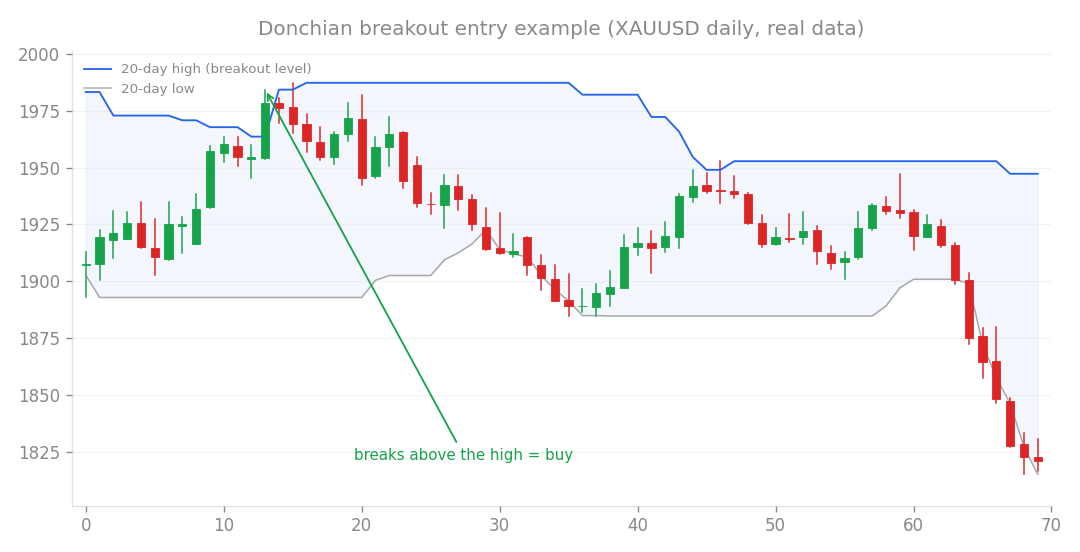
Breakout entry example (XAUUSD daily, real data): buy when price breaks above the recent high.
We’re always looking for new ways to refine our algorithmic trading strategies (EAs) and find that elusive “edge” in the market. This time, I dived into two interesting areas: the trend-following potential of Silver (XAGUSD) and the utility of the Kaufman Efficiency Ratio as a trend filter.
What’s the idea?
First up, Silver (XAGUSD) trends. Gold (XAUUSD) is known for its strong, clean trends that can be quite profitable for trend-following EAs. I wondered if Silver, often seen as Gold’s little sibling, shared this characteristic. Could we simply apply our successful Gold strategies to Silver and find another consistent profit source? Secondly, I explored the Kaufman Efficiency Ratio (ER). This is a clever little indicator designed to measure how “efficient” a trend is. Think of it like this: if a market moves straight up or down, that’s a very efficient trend. If it wiggles up and down a lot but still ends up higher, that’s less efficient. The ER is calculated as the absolute change over a period divided by the sum of the absolute changes of each individual bar within that period. In other words, it tells us if the market is moving decisively in one direction or just chopping around. The goal was to use it as a quality filter, only allowing our EAs to trade when the trend was “efficient” enough, hoping to avoid choppy, unprofitable periods.
How I tested it
For Silver, I took two common trend-following approaches:
- A breakout strategy: This EA looks to enter trades when the price breaks above or below a recent high or low, signaling the start of a new trend.
- An ATR candle strategy: This uses Average True Range (ATR), a measure of market volatility, to identify strong directional moves based on candle size.
I ran these strategies across historical Silver data to see if they could consistently find profitable trends.
For the Kaufman Efficiency Ratio, I integrated it into a basic, un-optimized “bare breakout” strategy. This allowed me to see its raw impact without the influence of other complex optimizations. The idea was to set a minimum ER threshold (
er_min) – only if the market’s efficiency ratio was above this level would the breakout signal be considered valid for a long trade.
What happened?
Let’s break down the results for each idea.
Silver: Not so shiny after all
The results for Silver were, unfortunately, quite clear: no robust edge found.
- The breakout strategy managed a modest +5.8% profit, but only in 2 out of 6 test periods. That means it was profitable less than half the time, which isn’t reliable enough.
- The ATR candle strategy performed even worse, losing a significant -33% in 1 out of 6 test periods. In other words, neither strategy showed consistent profitability. This suggests that Silver simply doesn’t behave like Gold in terms of trend-following. While Gold often exhibits clean, strong trends, Silver tends to be much noisier. It doesn’t have the same “clean” trending characteristic, making it a much harder instrument for these types of EAs. It seems that the “metal trends” we often see are quite specific to Gold. While Silver and Gold do have some correlation (I found it to be around 0.44, meaning they sometimes move together but often go their own way), it’s not enough to simply port Gold’s success to Silver. Because of this lack of a strong, reliable edge, Silver won’t be added to our core strategies.
Kaufman Efficiency Ratio: A good tool, but not a magic bullet
The Kaufman Efficiency Ratio showed some promise, but ultimately didn’t make the cut for existing optimized systems. When applied to the “bare breakout” strategy, it did improve performance. The strategy went from being profitable in 3 out of 6 test periods to 3-4 out of 6 periods. This is a marginal improvement – a step in the right direction, but not a huge leap. It didn’t reach the 5 out of 6 periods we’d ideally want to see for a truly robust enhancement. This outcome reminds me of what we found with the SMA slope filter in Research 94. These kinds of filters can indeed “polish” a very basic, un-optimized strategy. They help remove some of the bad trades that a simple breakout might make in choppy conditions. However, it seems they are unlikely to significantly improve already optimized systems. Our existing EAs are already quite refined, and adding ER on top didn’t provide enough extra benefit to warrant its inclusion.
What I learned
This research reinforced a few key lessons:
- Market uniqueness: Just because two assets seem similar (like Gold and Silver) doesn’t mean they behave the same way for trading strategies. Silver’s noisy nature makes it a poor candidate for the trend-following EAs that work well on Gold.
- The limits of filters: While filters like the Kaufman Efficiency Ratio can improve basic strategies by helping them avoid inefficient, choppy markets, their impact on already highly optimized systems tends to be minimal. They’re good for cleaning up raw signals, but not necessarily for adding a significant edge to an already sharp tool.
- Keep the tools: Even though the Kaufman Efficiency Ratio wasn’t adopted for our current EAs, the code for the ER filter functionality is a permanent asset. It’s now in our “toolbox” and could be useful for developing new strategies or for analyzing market efficiency in the future. Ultimately, both Silver trend-following and the Kaufman Efficiency Ratio filter, while interesting to explore, won’t be integrated into our main EA arsenal for now. But every test, whether it yields a breakthrough or a dead end, helps us understand the markets and our algorithms better!
How this connects
This verification builds on earlier ones (what failed before and what I tried this time, comparisons between approaches).