The Trend Continuation Illusion? What Our EA Test Really Revealed!
## What Was the Idea?
A beginner-friendly summary of the verification: “The Trend Continuation Illusion? What Our EA Test Really Revealed!”.

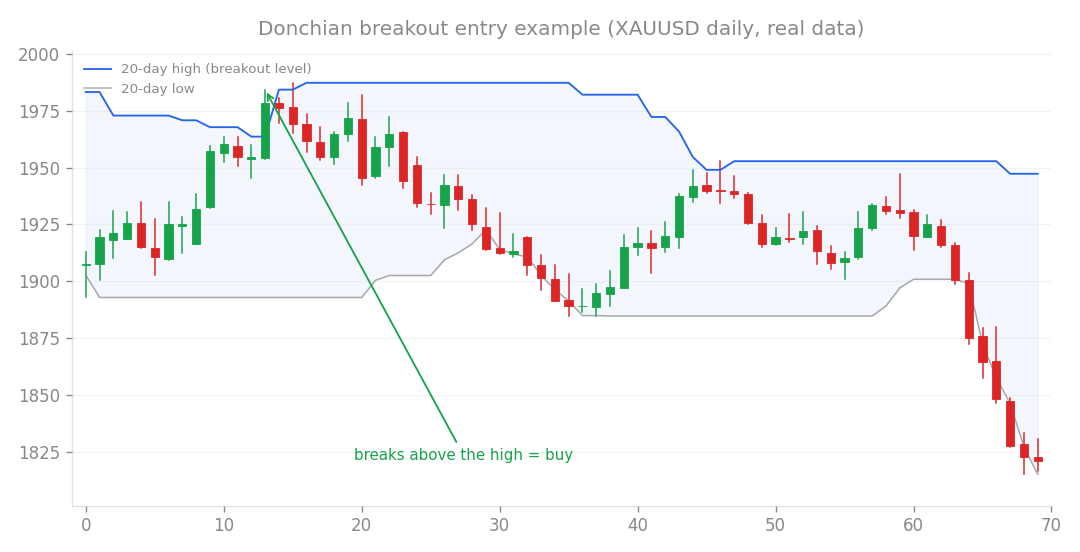
Breakout entry example (XAUUSD daily, real data): buy when price breaks above the recent high.
What Was the Idea?
We’re always looking for clever ways to spot profitable trading opportunities, especially with automated strategies (EAs). This time, we explored a “Continuation Breakout” idea. Imagine a market that’s already in an uptrend, then takes a little breather, consolidating in a tight range, before finally breaking out and continuing its original upward journey. That’s the core concept! Our goal was to mechanize this intuition, hoping to filter out lower-quality trades from a basic “plain breakout” strategy. Here’s how we defined it:
- Uptrend Confirmation: The market’s closing price needed to be above its Simple Moving Average (SMA), indicating a healthy uptrend.
- Recent Consolidation: We looked for a recent period where the market was “ranging” or consolidating. We measured this using the Average Directional Index (ADX) over a specific number of recent bars (
range_lookback). A low ADX suggests a weak trend, often seen during consolidation. - Breakout: After this consolidation, we needed to see the price break above the high of that recent range.
- Higher Timeframe (MTF) Confirmation: To add more conviction, we checked if the higher timeframe (specifically the H4 chart) was also showing an uptrend (H4 SMA also pointing up). This is called Multi-Timeframe (MTF) analysis.
- Significant Level: Finally, we wanted the breakout to happen near an “effective horizontal level” – essentially, a historically important support or resistance zone. Crucially, we built this system with absolutely no “leakage” or look-ahead bias, meaning the EA couldn’t “peek” into future price data, which would invalidate the test. We then compared this sophisticated strategy against a very basic “plain breakout” (our baseline, with all these extra filters turned off).
How I Tested It
To see if our Continuation Breakout idea held water, we put it through a rigorous two-stage testing process:
- In-Sample (IS) Testing: This is like practicing for a test with the answer key right there. We ran the strategy on a diverse set of historical data (all periods) to see if the filters improved performance. This helps us refine the idea, but it doesn’t tell us if it will work on new data. We looked at:
- Profit Factor (PF): This is your gross profit divided by your gross loss. A PF greater than 1 means you’re profitable. Higher is better!
- Drawdown (DD): This measures the maximum peak-to-trough decline in your account balance. Lower drawdown means less risk, which is always good.
- Forward Validation (Out-of-Sample, OOS): This is the real test – running the strategy on data it has never seen before. This is how we assess the strategy’s “robustness” or how well it performs in real, unpredictable market conditions. If a strategy works well here, it’s a strong sign it might have a true edge. We also performed an “ablation study,” which means we incrementally added our filters (range, MTF, levels) to see the individual and combined impact on performance. A key part of our forward validation was checking against “robustness criteria.” For a strategy to be considered robust, it needed to meet 5 out of 6 predefined criteria, which cover things like consistent profitability across different market cycles, low sensitivity to parameter changes, and overall stability.
What Happened?
Initial In-Sample (IS) Results: Looked Promising!
When we first tested the Continuation Breakout idea on our historical data, the results were encouraging! Adding our filters did seem to improve the trade quality:
- The Profit Factor (PF) jumped from 1.06 (for the plain breakout) to a much healthier 1.14.
- The Drawdown (DD) significantly reduced from -21% to a more manageable -14%. In other words, the filters successfully weeded out lower-quality trades, making the strategy look better and less risky on the data it had already seen. This selective effect was definitely real, confirming that our hypothesis about avoiding choppy trades was valid in principle.
Forward Validation (OOS): The Decisive Blow
However, the true test came with forward validation (Out-of-Sample), where the strategy faced unseen market data. And here’s where we hit a wall: all our Continuation Breakout variants failed to meet our robustness criteria (5 out of 6). Let’s break down the OOS performance of each variant:
- Plain Breakout: This basic strategy managed a +24.4% return but only met 3 out of 6 robustness criteria.
- Adding only the Range Filter: This version actually performed worse, with -0.3% return and only met 2 out of 6 criteria. This clearly showed that a “consolidation gate” by itself doesn’t give you an edge.
- Adding Range + MTF: This improved things slightly to +18.2% return, meeting 4 out of 6 criteria. Better, but still not robust enough.
- Adding Range + MTF + Levels: This was our best performer, achieving +32.9% return and also meeting 4 out of 6 criteria. While this looks like a decent return, the improvement over the plain breakout was so marginal that it fell within the realm of “selection noise” – meaning it could just be a fluke of that particular test period, not a truly robust improvement. In other words, while the filters looked good on past data, they didn’t consistently add robust value when faced with new market conditions.
Deeper Dive: It’s Not a New Edge
We then looked at the “core correlation” of our Continuation Breakout strategy with our existing, proven trend-following strategies. The correlation was a high +0.83. This told us something very important: this wasn’t a new, independent trading edge. Instead, it was simply a more selective way to enter the same trend-following trades we already knew about. It’s like finding a slightly better shovel for an existing gold mine, rather than discovering a brand new mine! We also examined the risk profile:
- Max 1-Day Drawdown (M1): The strategy saw a worst-case 1-day drawdown of 5.19% (with a small risk setting of 0.003), which was hit daily. This indicates a concentrated risk profile.
- Sharpe Ratio: While the Sharpe Ratio was a smooth 1.05 (a measure of risk-adjusted return), this strategy wouldn’t provide diversification because it’s so highly correlated with our existing trend-following approaches.
What I Learned
The big takeaway here is that while the structure of our hypothesis (trend → consolidation → continuation) does capture real market movement and improves trade quality in-sample, when we tried to mechanize it, the strategy ultimately converged with existing trend-following edges and didn’t offer any robust, independent superiority.
This aligns perfectly with conclusions from our past studies (like Research 62 and 86), where filters often improve in-sample quality but fail to outperform a plain strategy in forward validation. Our overall conclusion remains consistent: the most robust price edge is simply “trend long,” and many “selective variants” are just high-correlation rediscoveries of this fundamental truth.
So, no changes to our confirmed trading systems based on this study. However, the ContinuationBreakout code remains a valuable learning tool for future research.
Further Explorations (User-Requested Variants)
We also explored three user-requested variants of the Continuation Breakout: A) Diagonal Channels: Instead of horizontal support/resistance, we tried using diagonal channels. This variant only met 4 out of 6 robustness criteria and failed, consistent with our earlier Research 75 which found horizontal levels generally superior to diagonal ones. B) Volatility Contraction (Narrow Range - NR): This variant looked for breakouts after a period of extreme volatility contraction (where the price range was very narrow). This one was initially very attractive, showing 5 out of 6 robustness criteria in its first forward validation (and 4 out of 6 for the specific NR filter). However, upon deeper scrutiny, it fell apart:
- Parameter Robustness: Its parameter robustness (how stable it was across different settings) was only 3 out of 8, far below our 5 out of 6 threshold. The NR variant itself fluctuated between 4/6 and 5/6, indicating it was right on the edge of our criteria – a sign of potential instability.
- Core Correlation: Its correlation with existing trend-following edges was even higher at +0.86 (compared to +0.83 for the ADX version). This confirmed it was even more of the same edge, not a new one.
- Max 1-Day Drawdown (M1): It showed a worse worst-case 1-day drawdown of 7.64%! This was due to sharp price jumps and gaps often seen after periods of extreme volatility contraction, which exacerbated intraday losses. C) Earlier Entry: This variant tried to enter trades slightly earlier during the breakout. While it boosted in-sample returns, it only met 4 out of 6 robustness criteria in forward validation, so it also failed.
The Ultimate Lesson: Our Validation Framework Works!
The initial “attractive 5 out of 6” for the NR variant was a classic example of “boundary noise” that can appear when you test multiple variations (we tested 7 in total). Our multi-stage validation gates – checking parameter robustness, correlation, and max daily drawdown – successfully caught this false positive in the later stages. This is a pattern we’ve seen before (e.g., in Research 60 and 82). All three user-requested variants, like the original Continuation Breakout, ultimately lacked independent, robust superiority. They all converged to be “slightly different ways to enter the same trend-following trades” (with correlations between +0.83 and +0.86). This study, despite not yielding a new trading system, is strong proof that our rigorous validation framework is functioning exactly as it should! It effectively weeds out promising-looking but ultimately non-robust strategies, protecting us from deploying systems that won’t hold up in real markets. No changes to our confirmed systems based on this research.
How this connects
This verification builds on earlier ones (what failed before and what I tried this time, comparisons between approaches).