Supercharging "Breakout_h1": Our EA Platform's Enhancement Test!
Welcome back to the blog! Today, we're diving deep into a fascinating strategy called. It's a prime example of how rigorous testing can reveal hidden
A beginner-friendly summary of the verification: “Supercharging “Breakout_h1”: Our EA Platform’s Enhancement Test!”.

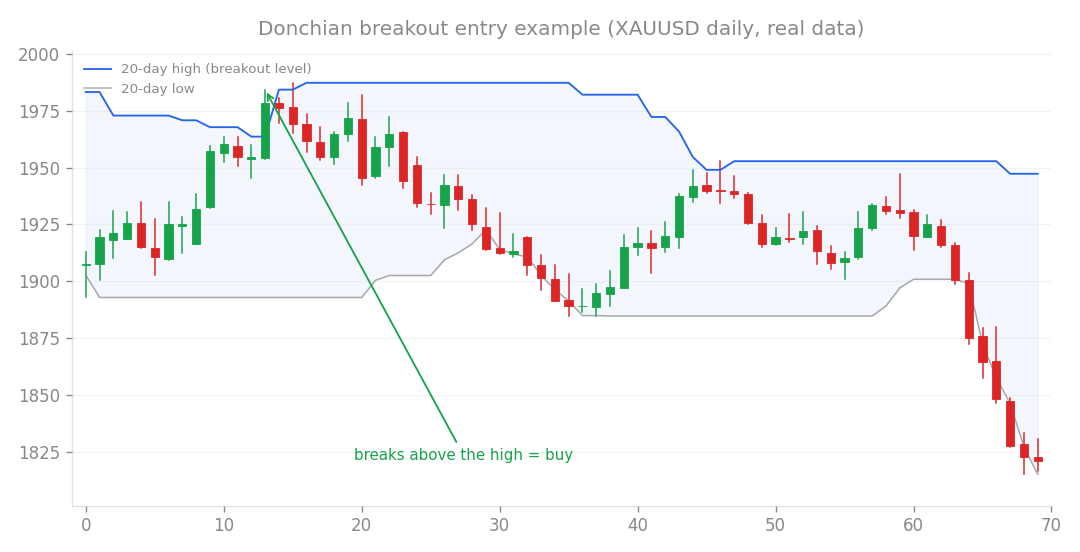
Breakout entry example (XAUUSD daily, real data): buy when price breaks above the recent high.
Welcome back to the blog! Today, we’re diving deep into a fascinating strategy called breakout_h1. It’s a prime example of how rigorous testing can reveal hidden flaws and lead to a much stronger trading system.
What’s the idea?
The breakout_h1 strategy is a trend-following system designed to catch big moves in the market. It was developed by a separate project (fto) and represents their “highest achievement” in strategy design.
Here’s how it generally works:
- Timeframe: It operates on the H1 (1-hour) chart, meaning it looks at data every hour.
- Long-only: It only takes “long” trades, betting that prices will go up.
- Entry/Exit: It uses Donchian Channels (think of them as dynamic price bands) to spot breakouts. When the price moves above the upper band, it signals an entry (en30); when it falls below a lower band, it signals an exit (ex25).
- Trend Filter: A Simple Moving Average (SMA150) acts as a filter, ensuring trades are only taken in the direction of the longer-term trend.
- Stop Loss: An ATR (Average True Range) based stop-loss (SL3.0ATR) helps manage risk by automatically closing trades if they go too far against the strategy, adapting to market volatility.
- Pairs: It trades 7 specific instruments: Gold (XAU/USD) and 6 Yen pairs (USDJPY, EURJPY, AUDJPY, GBPJPY, CHFJPY, NZDJPY).
What’s really interesting is that this strategy,
breakout_h1, perfectly matches the default settings of our ownBreakoutLongstrategy in the EA (Expert Advisor) framework. It’s like two independent teams, working separately, came up with the exact same blueprint for success! This convergence is a strong initial sign that the core idea has merit.
How I tested it
To truly verify and strengthen breakout_h1, I put it through our EA framework’s rigorous “strict gates.” This means:
- Same Data, Different Engine: We used the exact same real-world historical data from Axiory (a broker) as the
ftoproject. This is crucial because it eliminates any excuses about data differences. However, we ran it through a different simulation engine. Think of it like testing the same car design on two different, highly precise simulators. Our engine is designed to be very strict about execution costs and real-world conditions. - M1 Intraday Verification: Unlike the original
ftotests, we included detailed M1 (1-minute) intraday checks. This is vital for understanding how a strategy performs minute-by-minute, especially when dealing with prop firm daily drawdown limits. - Walk-Forward Testing: This tests the strategy’s robustness by optimizing it on one period and then testing it on a subsequent, unseen period.
- Monte Carlo Simulation: This runs thousands of variations of the strategy with slight random changes to see how stable its performance is under different market scenarios. Initially, I thought we were using completely independent data sources, which would have been great for cross-verification. But after a deeper dive, I found the historical data files were byte-for-byte identical to Axiory’s real data. This means our test wasn’t about “independent data” but rather “same data + different (stricter) engine + M1 intraday insights.” Any performance differences would come down to the simulation engine’s realism, execution cost models, how drawdown (DD) is scaled, and how “overlay” features are handled, not the underlying price history.
What happened?
Our rigorous testing revealed some eye-opening insights, challenging some of fto’s original assumptions and recommendations.
Unveiling Hidden Weaknesses: The “Harmful” Levers
fto had two additional “levers” or features that hadn’t been fully verified, and our EA framework put them to the test. The results were clear: these features turned out to be detrimental.
- The “Short Sleeve”:
- The Claim:
ftosuggested adding a “short sleeve” (a component that trades in the opposite direction, i.e., selling) to the long-only strategy. The idea was to combinelong + 0.4 * shortto potentially double the risk-adjusted returns and act as a hedge with a -0.18 correlation. - Our Findings: When we tested the short component on its own using our EA engine, it was a pure money-loser! It showed a net negative performance of -17.5% in out-of-sample (OOS) data and a whopping -43.3% in in-sample (IS) data. The correlation between the long and short components was a negligible -0.05, meaning it offered almost no hedging benefit; they were practically uncorrelated. When combined with the long strategy, the overall “basket efficiency” (a measure of profitability vs. risk, where higher is better) declined significantly, from 5.04 (long only) to 3.80 (long + 0.4 short). Even Monte Carlo and M1 intraday performance worsened.
- In other words: Adding the short sleeve was like attaching “extra brakes” to a perfectly good car that just slowed it down without making it any safer. It was a “pure drag” on performance. This confirmed earlier research that the short side of this type of strategy tends to have a negative expected value (EV). Since we used the same data, there’s no arguing with these results based on data differences. We strongly recommend against deploying the short sleeve.
- The “Overlay”:
- The Claim:
ftobelieved an “overlay” feature could reduce asymmetric drawdown (DD) from 32% to 20%. An overlay is often a higher-level filter or management system meant to improve overall stability. - Our Findings: We found the exact opposite! With the overlay on, the strategy’s efficiency was halved, dropping from 9.40 (overlay OFF) to 5.04. Returns plummeted from +284% to +159%, while the drawdown remained largely unchanged. This aligns with our previous EA study 52, which also found overlays weren’t improving things.
- In other words: This “safety feature” simply drained power and reduced returns without providing the promised drawdown reduction. Turning the overlay OFF actually improved performance significantly.
The Risk Reality Check: Daily Drawdown Breaches
Perhaps the most critical finding was related to risk management. fto had recommended a risk allocation of 0.3-0.5% of capital per pair.
- The Problem: When we ran the
breakout_h1strategy atfto’s recommended risk levels with our M1 intraday checks, it repeatedly hit daily -5% drawdown limits! For example, a risk of 0.004% per pair led to a worst-case drawdown of 11.55% over just 3 days. A 0.003% risk still resulted in 8.95% over 3 days. The first breaches occurred on significant market events like the USDJPY intervention day and a gold gap on April 29, 2024. - In other words:
fto’s recommended risk, while seemingly small, was actually excessive when subjected to minute-by-minute scrutiny. If you were trading this with a prop firm (a company that funds traders but has strict daily loss limits), you would be failing very quickly! It’s like driving a race car at speeds only meant for a regular street car; you’re bound to crash. - The Solution: Our tests determined that the safe risk limit to avoid any M1 intraday breaches was roughly 0.0015% per pair. This is 1/2 to 1/3 of
fto’s original recommendation! At this safer level, the strategy still delivered a total return of +75% with a controlled drawdown of -12.3%, and solid Monte Carlo stability (84% passed STEP1, 74% overall, only 8% disqualified).
Minor Tweaks: Calendar Sleeve
We also explored adding a “calendar sleeve” – a small component designed to capitalize on seasonal or calendar-based patterns. While it showed a tiny positive correlation (0.28) and a minuscule return increase (+3.7% over 11 years), the overall impact was negligible, barely moving efficiency or Monte Carlo scores. This confirmed our earlier research that while calendar effects can be real, their scale is often too small to make a significant difference.
What I learned: The Hardened Strategy
This extensive cross-verification process provided invaluable lessons and led to a significantly improved version of the breakout_h1 strategy.
The true strengthening of breakout_h1 comes from three key adjustments:
- Risk Correction: Adjusting the risk down to a prop-firm-safe level of approximately 0.15% per pair, based on our M1 intraday verification. This is 1/2 to 1/3 of
fto’s original recommendation, but it ensures the strategy can withstand real-world volatility without hitting daily loss limits. - Overlay OFF: Disabling the “overlay” feature, which proved to be a drain on performance rather than a benefit.
- Short Sleeve Rejection: Completely removing the “short sleeve” due to its consistently negative performance and lack of genuine hedging.
In essence, our EA Core System v1.2.0 is the hardened and improved version of
breakout_h1. It takes the same strong trend-following core but enhances it with:
- Multi-Timeframe (MTF) Diversification: Instead of just H1, it incorporates H1, H4, and D1 timeframes. This spreads risk, reduces exposure to intraday spikes, and ensures M1 safety.
- Overlay OFF: As verified, this is the optimal setting.
- Truly Uncorrelated Sleeves: We’ve augmented the strategy with genuinely uncorrelated components, like “Index” (correlation 0.16), “Sat2” (correlation 0.5), and “Calendar,” which provide real diversification benefits, unlike the ineffective short sleeve. This independent verification by our EA framework clearly demonstrates that our design choices for hardening the strategy were superior.
Why the Numbers Differed: Engine Strictness
You might be wondering why fto’s original numbers (e.g., monthly +2.62% return with 9.4% drawdown) were so different from our initial findings, even though we used the same Axiory data.
- It’s the Engine, Not the Data: The difference wasn’t due to data (we confirmed byte-level identical data). It was purely down to the strictness of our EA engine’s simulation.
fto’s model, while good, likely used a more optimistic execution model (e.g., ideal fills at the next bar open), different drawdown scaling (DD10%), and different handling of the overlay. Our EA framework, however, applies real-world costs, slippage, and precise M1 intraday checks. - Regime Dependence:
ftoitself had warned about regime dependence, noting that the strategy performed particularly well during the 2021-2026 period of Yen depreciation and high gold prices. They had even adopted “real-world correction values” (monthly +2.62%), acknowledging these engine differences. - The Real Drawdown Story: A major discovery was the true cause of the significant drawdown we observed (-25% to -38%). We initially suspected gold (XAUUSD) or specific problematic years (2025-2026) might be “contaminating” the results. However, removing gold or those years made almost no difference to the drawdown figures (-37.4% and -37.9%, respectively). This led to a crucial insight: the -38% drawdown was not due to a single bad actor but rather correlated drawdown across all 7 currency pairs. During challenging periods, multiple pairs often moved against the strategy simultaneously, leading to larger portfolio drawdowns. This is a vital lesson about diversification and portfolio risk.
Ultimately, our EA framework’s biggest new contribution was highlighting the M1 intraday daily -5% breach risk, a dimension
ftohad not calculated. This level of granular scrutiny is essential for any strategy intended for real-world trading, especially under prop firm rules. This rigorous process allowed us to take a promising strategy, identify its hidden vulnerabilities, and transform it into a robust, prop-firm-safe system ready for the challenges of live trading.
How this connects
This verification builds on earlier ones (what failed before and what I tried this time, comparisons between approaches).