YouTube FX Strategy Exposed: Our EA Test Found "False Positives"!
## Unmasking YouTube FX Strategies: The EMA Cross & Pullback Test
A beginner-friendly summary of the verification: “YouTube FX Strategy Exposed: Our EA Test Found “False Positives”!”.

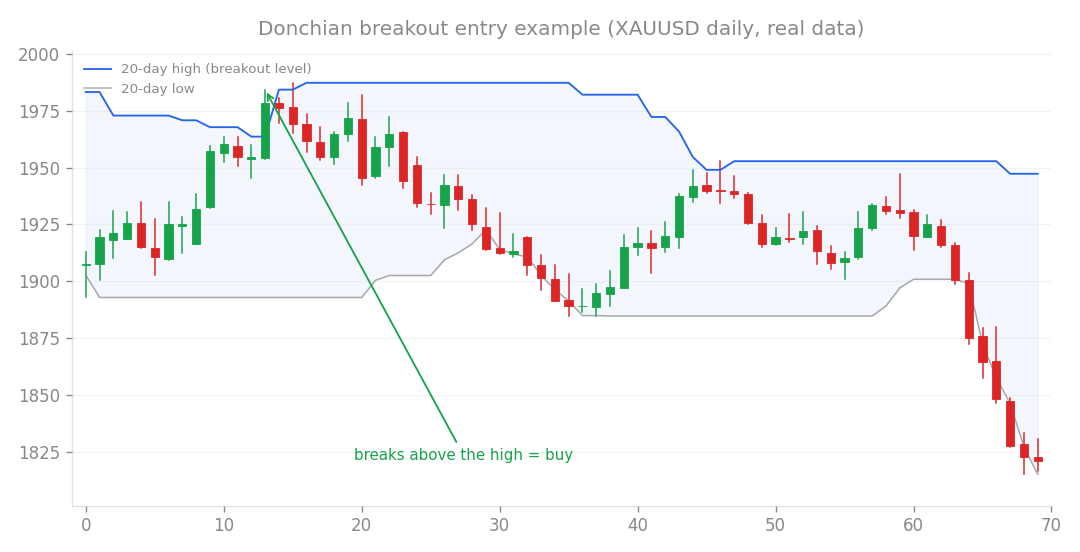
Breakout entry example (XAUUSD daily, real data): buy when price breaks above the recent high.
Unmasking YouTube FX Strategies: The EMA Cross & Pullback Test
We’ve all seen those captivating YouTube videos promising easy profits with a simple trading strategy. As your EA verification blog editor, I’m always curious to put these claims to the test. This time, we tackled a popular approach: the 4-hour (H4) EMA cross with a pullback entry. Was it the holy grail, or just another mirage? Let’s dive in!
What’s the Idea?
This strategy, often touted for catching “Elliott Wave 3” moves, is pretty straightforward on paper. It uses two Exponential Moving Averages (EMAs) on the H4 chart:
- Trend Confirmation: When the faster 20 EMA crosses above the slower 200 EMA, it signals an uptrend. The reverse signals a downtrend.
- Pullback Entry: After the cross, we wait for the price to “pull back” and touch the 20 EMA. The candle that touches the 20 EMA is our “reference candle.”
- Entry Trigger: We enter a trade when the body of a subsequent candle breaks above the high (for longs) or below the low (for shorts) of that reference candle.
- Both Ways: A key feature was “both-way” trading, meaning we could take both long and short signals as they appeared.
- Stop Loss (SL) & Take Profit (TP): The SL was set at the low/high of the reference candle. The original video suggested a discretionary TP (e.g., “a prominent previous high/low”), but for our automated testing, we mechanized this to a 2R risk-reward ratio (meaning the take profit was twice the stop loss distance).
To make sure we were testing this fairly, we built a dedicated
EmaCrossPullbacksystem, ensuring it followed the rules without any “leakage” or forward-looking bias.
How I Tested It
Verifying any EA isn’t just about looking at past performance. We use a robust, multi-stage screening process:
- Strategy Extraction Tool: First, we developed a new tool (
youtube_extract.py) that uses AI to analyze YouTube videos and automatically convert the described trading rules into a structured, machine-readable format. This makes it super efficient to mechanize and test any video strategy going forward! - Initial Forward Validation (Out-of-Sample - OOS): This is crucial. We test the strategy on market data it hasn’t seen before. We looked at various configurations (longs only, shorts only, both-way) and risk-reward settings (e.g., 2R). We also look for “robustness criteria,” like consistently profitable years (e.g., 5 out of 6 years profitable).
- Deeper Robustness Checks (The “Back Gate”): If a strategy passes the initial forward validation, it moves to the “back gate.” Here, we intentionally try to break it by:
- Parameter Robustness: Slightly tweaking the EMA periods (e.g., 20 EMA to 15 or 25, 200 EMA to 150). A truly robust strategy shouldn’t fall apart with minor adjustments.
- Timeframe Robustness: Testing it on different timeframes (e.g., H1 and Daily) to see if the “edge” (the statistical advantage) persists. A genuine market dynamic should ideally work across multiple scales, not just one.
What Happened? (The Initial Spark)
When we ran the initial forward validation, most configurations of the EMA cross + pullback strategy performed poorly. For example, long-only with a swing-based TP was barely profitable (+0.2%), and others were outright negative.
However, one configuration did catch our eye: both/rr2 (trading both long and short signals with a 2R take profit). This variant showed a +9.5% profit and, even better, was profitable in 5 out of 6 years during our forward validation!
This was a rare and exciting moment because, frankly, “both-way” strategies often struggle to pass our initial screens. It defied our initial expectation that such a strategy would collapse. We thought we might have a potential candidate on our hands!
What Happened Next? (The Reality Check)
Despite the initial promise, our multi-stage screening process is designed to catch “false positives”—strategies that look good at first glance but aren’t truly robust. And unfortunately, this is exactly what happened here.
1. Parameter Robustness: A House of Cards
When we started tweaking the parameters slightly, the strategy quickly fell apart.
- Changing the fast EMA from 20 to 15 or 25, or the slow EMA from 200 to 150, or even the “wait” period (how many candles after the pullback) to 30, often led to:
- Negative forward returns.
- Fewer than 4 profitable years. This isn’t what we see with truly robust systems, where small perturbations still yield positive results. It was like a delicate house of cards—touch one part, and the whole thing collapses. This strategy failed our parameter robustness test (only 8 out of 12 perturbations remained positive or stable).
2. Timeframe Robustness: Overfitting to Noise
This was the nail in the coffin. A truly robust strategy should reflect genuine market dynamics that exist across different timeframes. But this EMA cross + pullback strategy showed a critical weakness:
- On the H1 (1-hour) chart, it was catastrophic: -25.2% profit with only 2 out of 6 profitable years.
- On the H4 (4-hour) chart, it was still the best at +9.5% with 5 out of 6 profitable years.
- On the D1 (Daily) chart, it was barely breathing: -0.3% profit with only 1 out of 6 profitable years. In other words, this strategy only functioned on the 4-hour timeframe. This is a classic sign of overfitting—the strategy isn’t capturing a universal market truth, but rather exploiting specific “noise structures” unique to that particular H4 timeframe. It’s like finding a pattern in a single snowflake and expecting it to apply to all snowflakes. Real trends and breakouts tend to show some persistence across different timeframes, even if their performance varies.
What I Learned
So, what’s the verdict? Despite an initial glimmer of hope, this YouTube EMA cross + pullback strategy is a false positive and not deployable as a mechanical system.
- The “Both-Way” Myth: Our findings are consistent with previous research (studies 1, 2, 3, 42, 54), which suggests that EMA cross + pullback strategies, especially those trying to trade “both ways” simultaneously, often fail to deliver a persistent edge when fully mechanized without human discretion.
- The Power of Robust Testing: This entire exercise perfectly demonstrates the value of our multi-stage verification process. It successfully identified a strategy that passed the initial forward validation (5/6 profitable years!) but correctly flagged it as a false positive in the deeper robustness checks. Our testing framework is working as intended!
- The Missing Discretion: The original YouTube video likely included discretionary elements—like judging the “first wave” or selecting “prominent” highs/lows for TP, or actively avoiding ranges. When we strip these subjective elements away and mechanize the core rules, the statistical edge disappears.
- A Note on “Shorts”: We also tested a related strategy from another YouTube video, focusing on short-only trades on metals (like silver). This also failed completely in forward validation, reinforcing our general observation that short-only strategies often struggle to find a consistent edge in our tests. Ultimately, while the specific strategy didn’t pan out, our commitment to rigorous testing means we’re constantly refining our understanding of what actually works in algorithmic trading. And hey, we got a cool new YouTube strategy extraction tool out of it!
How this connects
This verification builds on earlier ones (what failed before and what I tried this time, comparisons between approaches).
- Gold Trading: We Uncovered the Edge of Donchian Trend Following
- Market Weather Forecast: MTF RSI+SMA — The Ultimate Trend…
- Trendline Break Strategy: Can This Unique EA Catch the First…
Code to reproduce
You can reproduce this with the following scripts (see repo).
scripts/tools/youtube_extract.py