Volume Profile vs. Swing Levels: Which Gives Your EA The Edge?
## What's the Big Idea? A New Level-Finding Tool for Our EAs!
A beginner-friendly summary of the verification: “Volume Profile vs. Swing Levels: Which Gives Your EA The Edge?”.
What’s the Big Idea? A New Level-Finding Tool for Our EAs!
Here in the lab, we’re always on the hunt for ways to make our algorithmic trading robots (EAs) smarter and more robust. Our current champion framework, built on the solid foundations of Dow Theory, Multi-Timeframe Analysis (MTF), and a trusty pullback strategy, has proven itself quite effective. It uses what we call “swing levels” (from our Research 73) to pinpoint key areas where price is likely to react.
But what if there’s another powerful way to identify these crucial levels? That’s exactly what we explored in this study. We wanted to see if Volume Profile – a fascinating tool that shows where the most trading activity has occurred – could be integrated into our proven framework as an even more effective “level filter.” Our goal was simple: Could it outperform or at least complement our existing swing levels, especially for FX trading?
How We Put Volume Profile to the Test
First, let’s quickly define Volume Profile. Imagine a busy marketplace. Volume Profile essentially tells you which specific prices saw the most transactions. It’s like seeing a histogram turned on its side, showing volume at each price level rather than over time.
Two key concepts within Volume Profile are:
- Point of Control (POC): This is the price level where the highest volume was traded. Think of it as the busiest stall in our marketplace analogy.
- Value Area: This is the price range where the majority (typically 70%) of the total volume was traded. It’s the core, most active part of our marketplace.
We integrated two different configurations of the
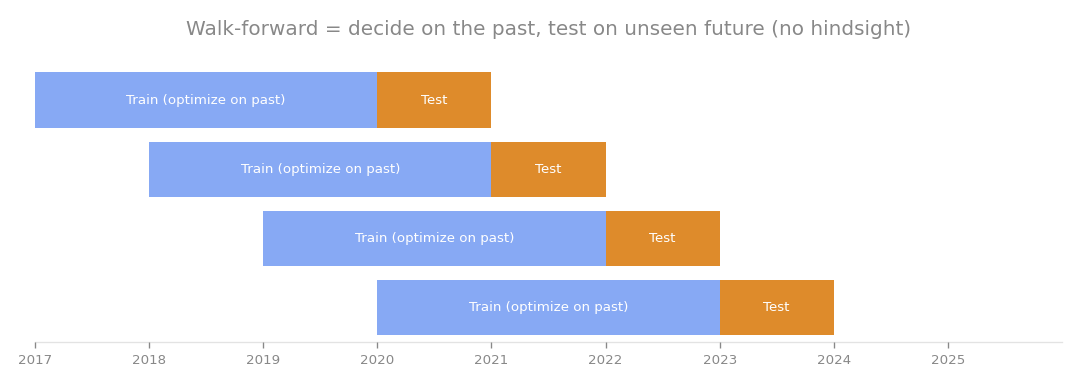
Volume Profile(let’s call themvp0.5andvp1.0, referring to internal parameters) into our existing Dow+MTF+Pullback EA. Then, we put it through our rigorousforward validationprocess. This isn’t just backtesting on old data; it’s like setting up a simulated trading environment to see how the EA performs on unseen market data, giving us a much better idea of real-world consistency. Our benchmark for success was our existinglevel20system (based on swing levels), which had previously achieved a solid +42.2% profit while passing 5 out of 6 of our internal robustness and consistency criteria. We wanted to see if Volume Profile could match or exceed that.
The Results Are In: Did Volume Profile Deliver?
Alright, drumroll please! The short answer is: Volume Profile showed promise, but it didn’t quite dethrone our reigning champion, swing levels, for FX.
Here’s what we found:
vp0.5(Volume Profile configuration 1): This version generated a respectable +30.6% profit. However, it only passed 4 out of 6 of our robustness criteria. In other words, while it made money, it wasn’t as consistently reliable or robust as our benchmark.vp1.0(Volume Profile configuration 2): This configuration was less impressive, yielding +16.6% profit and also only passing 4 out of 6 criteria. So, while both Volume Profile configurations were profitable, they fell short of our 5/6 benchmark for consistency and reliability. What about combining them? We also tested usinglevel20together withvp0.5. This combination actually produced the highest profit: +49.0%! Sounds great, right? But here’s the catch: it still only passed 4 out of 6 of our criteria. This is a crucial point. A higher profit is exciting, but if the consistency (our “pass criteria”) drops, it suggests the strategy might be less reliable and more prone to unexpected drawdowns or failures in different market conditions. It’s like a car that goes incredibly fast but struggles to pass its safety inspection. This experiment helped us establish a clear hierarchy for our level-finding filters:
swing-levels(from Research 73): Still the champion, consistently passing 5/6 criteria. ✅volume-profile: A decent contender, but consistently at 4/6 criteria. △channelsandPrice Action (PA)based filters: These performed poorly, withchannelsonly passing 1/6 andPAactually degrading performance. ❌ Our conclusion for FX was clear:Volume Profileisn’t “garbage” – it’s definitely not a worthless tool. However, it simply doesn’t surpass the effectiveness ofswing levelswhen applied to our FX framework. Our Research 73 onswing levelsremains the gold standard for now!
What We Learned & What’s Next
This study reinforced the continued importance of swing levels in our EA framework for FX. While Volume Profile didn’t quite make the cut for FX here, we’re not discarding it entirely! We believe the Volume Profile engine still holds potential, especially for instruments where volume data is considered more “real” and impactful, such as stock indices or commodities like gold. We’ll definitely keep it in our toolbox for future investigations into those markets.
Ultimately, this research highlighted a key limitation: relying on single, individual filters might only get us so far. Each filter has its strengths and weaknesses.
This realization is leading us to our next major step: the concept of Confluence. Imagine if multiple technical analysis tools – our levels, profile, pivots, and Fibonacci levels – all align or “overlap” at the same price point. When several strong signals line up like that, it creates a much more powerful and reliable trading opportunity. It’s like having several traffic lights all turn green at once, giving you a clear path forward!
Our next big project is to integrate all these individual engines into a single “confluence score.” This is the exciting culmination of all our foundational work, aiming to build the “strongest combo” possible for our EAs. Stay tuned – the search for algorithmic trading excellence continues!
How this connects
This verification builds on earlier ones (what failed before and what I tried this time, comparisons between approaches).