Existing Trend EAs on Shorter Timeframes: Will More Trades Boost Profits?
## What's the idea?
A beginner-friendly summary of the verification: “Existing Trend EAs on Shorter Timeframes: Will More Trades Boost Profits?”.
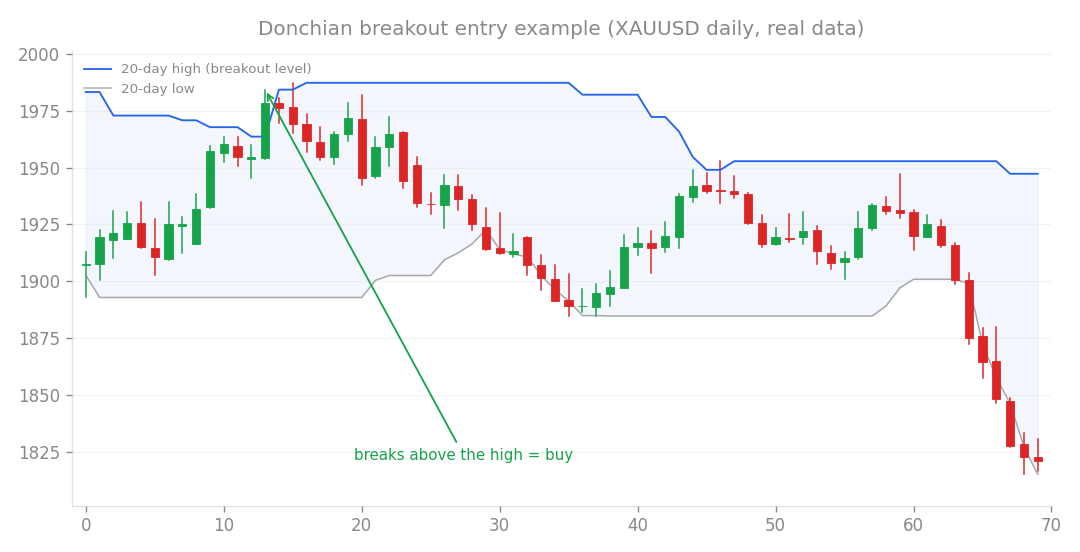
Breakout entry example (XAUUSD daily, real data): buy when price breaks above the recent high.
What’s the idea?
Ever wondered if an Expert Advisor (EA) – that’s an automated trading program – that performs beautifully on, say, an hourly chart could do even better if you just sped it up and ran it on a 5-minute chart? It’s a common thought: more trades, more opportunities, right?
Well, we took a couple of our established, proven trend-following systems, BreakoutLong (which only takes long trades) and DonchianBreakout (which trades both long and short), and put this idea to the test. The goal was to see what happens when you take a system designed for slower, longer-term trends and force it into the fast lane of shorter timeframes (TF), specifically going from H1 (1-hour charts) all the way down to M5 (5-minute charts). Crucially, we kept all the internal parameters of the EAs exactly the same – no re-optimization for the shorter TFs, because we wanted to see the inherent performance change.
How I tested it
We ran extensive backtests on these EAs using data from 2019 to 2025. To make sure our results were as realistic as possible, we used a robust testing methodology (robust5) and included per-symbol spreads, meaning the actual transaction costs for each currency pair were factored in.
Here’s the breakdown of our experiment:
- Timeframe Descent: We started with the H1 chart as our baseline, where these systems are known to perform well. Then, we progressively moved down to M30 (30-minute), M15 (15-minute), and finally M5 (5-minute) charts. We watched how the EA’s behavior changed, noting things like the number of trades, average holding period, Drawdown (DD – the maximum drop from a peak in your account balance), and Profit Factor (PF – gross profit divided by gross loss; a PF > 1 means profitable).
- Cost Sensitivity Analysis: This is super important for short timeframes, where even tiny transaction costs can eat into profits. We simulated additional slippage (the difference between your intended entry/exit price and the actual executed price) to see how fragile the systems were to realistic trading conditions.
What happened?
Let’s just say the results were a stark reminder that not all good things scale down!
The BreakoutLong System (Long Only)
When we took our reliable BreakoutLong system and moved it to shorter timeframes, we saw a clear and monotonous deterioration across the board. It was like trying to use a deep-sea fishing rod for fly fishing – completely the wrong tool for the job.
- H1 (Baseline): This system was solid, showing a +31% profit, a healthy PF of 1.36, and a manageable DD of -8.6%. It traded 1,428 times, which is a good sample size.
- M30: Performance dipped to +37% (slightly higher profit percentage, but this is misleading), with a PF of 1.19. The DD almost doubled to -16.2%. The number of trades surged, of course. While still profitable, it was clearly a weaker version of its H1 self.
- M15: This is where things started getting truly marginal. We saw a meager +13% profit and a PF of just 1.02. That PF is barely above 1, meaning it was just scraping by. It traded significantly more, but with much less conviction. It was barely treading water.
- M5: This was a complete disaster! The system plummeted to -77% loss with a terrible PF of 0.76. In other words, for every dollar it made, it lost more than a dollar. It initiated a staggering 18,755 trades, but it was completely eaten alive by transaction costs and noise. We called it “complete cost death.” To summarize the trend: as we moved to shorter timeframes, the number of trades skyrocketed (from 1,428 on H1 to 18,755 on M5), the average holding period for trades decreased drastically, Drawdown increased significantly (from -8.6% to a whopping -85% on M5), and the Profit Factor steadily declined.
The DonchianBreakout System (Long & Short)
The DonchianBreakout system, which trades both long and short, fared even worse. While it managed a respectable +25% profit on H1, its performance on shorter timeframes was abysmal. On the M5 chart, it suffered a 100% total loss! This re-confirms a known issue: short trades, especially on shorter timeframes, are particularly vulnerable to costs and “false signals” (whipsaws), dragging down overall performance.
The Crucial Test: Cost Sensitivity
This is often the make-or-break factor for fast-paced trading strategies. We added simulated slippage to see how much tolerance each timeframe had for real-world trading costs.
- M5: As expected, it was already dead, and adding any slippage just confirmed its demise (PF dropped from 0.76 to 0.48). There was simply no way to make it work.
- M15: This timeframe was incredibly fragile. Just +0.5 pip of additional slippage immediately pushed its PF below 1 (from 1.02 to 0.96). This means the system only looked profitable under the most optimistic, zero-slippage conditions – completely unrealistic in live trading.
- M30: This showed a bit more resilience, tolerating up to +1 pip of slippage before its PF started to look truly concerning (dropping from 1.19 to 1.10). Still, it was a clear step down from H1’s robustness.
What I learned
The biggest takeaway is crystal clear: there is absolutely no benefit to taking a proven trend-following system and trying to run it on shorter timeframes without completely redesigning and re-optimizing it for that speed.
- M5 is completely dead due to costs. This experiment solidifies what we’ve seen in previous research (like the ORB system losing 96% or the collapse of gold scalping EAs). Trend systems simply can’t handle the noise and transaction costs of ultra-short timeframes.
- M15 has no real edge once realistic trading costs are factored in. It might look positive on paper with perfect conditions, but that’s not how the real world works.
- M30 is the absolute lower limit, but even then, it’s a significantly degraded version of the H1 system. Its Profit Factor is lower (1.19 vs. 1.36), and its Drawdown is almost double (-16.2% vs. -8.6%). This goes against our goal of achieving stable, low-DD profits for consistent withdrawals. This research strongly reinforces our existing conclusion: for established, robust trend systems, sticking to longer timeframes like H1, H4 (4-hour), or D1 (daily) is the correct approach. These timeframes allow trends to develop, reduce the impact of transaction costs, and provide a much more stable and predictable trading environment. Trying to force them into a scalping-like role is a recipe for disappointment and financial loss.
How this connects
This verification builds on earlier ones (what failed before and what I tried this time, comparisons between approaches).