Trendline Break Strategy: Can This Unique EA Catch the First Wave?
Today, we're diving into a fascinating trading concept: capturing the "first wave" after a trendline break and retest. The idea is simple yet compelli
A beginner-friendly summary of the verification: “Trendline Break Strategy: Can This Unique EA Catch the First Wave?”.

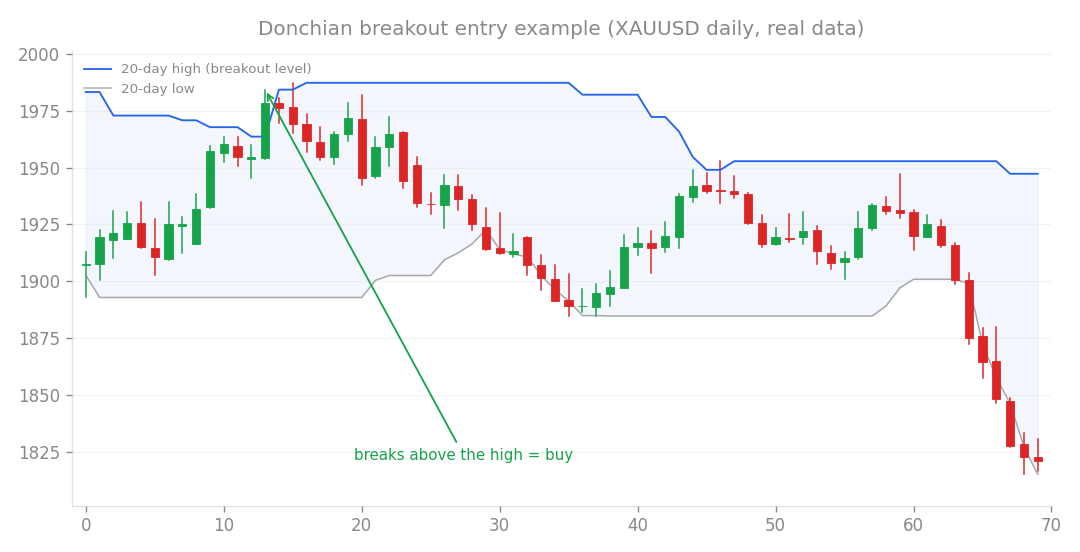
Breakout entry example (XAUUSD daily, real data): buy when price breaks above the recent high.
Today, we’re diving into a fascinating trading concept: capturing the “first wave” after a trendline break and retest. The idea is simple yet compelling, and we put it through our rigorous testing grinder.
What’s the idea?
Imagine a strong trendline, like a boundary that price usually respects. Our hypothesis was that when price finally breaks through this trendline (drawn by connecting the two most recent “swings” or fractals, ensuring our lines are robust and not “looking ahead” into the future), it won’t just keep going. Instead, it might often “retest” or “return move” back to the broken trendline, like a ball bouncing off a wall and coming back before heading in its new direction. Our strategy aimed to capture the first significant price movement – what we call the “1st wave” – that emerges after this retest is complete. This entire process was handled by a clever 3-stage state machine: Break -> Retest -> 1st Wave. We explored four different versions of this idea for an Expert Advisor (EA):
- Continuation (A): The break direction aligns with the overall market bias or prevailing trend.
- Reversal (B): The break direction goes against the prevailing trend. Each of these was tested in both long-only (buying only) and both-ways (taking both long and short trades) configurations. Our goal was an honest comparison to see which, if any, held an edge.
How I tested it
Our testing process is designed to be brutal, pushing EAs through multiple “gates” to weed out strategies that only look good on paper. We used a custom indicators.trendlines() function to draw our trendlines reliably, connecting confirmed fractal points to prevent any “look-ahead bias” – meaning the EA couldn’t cheat by seeing future price action.
We started with forward testing, which means running the EA on fresh, unseen market data, just like it would perform live. This is crucial because it tells us if the strategy works now, not just on historical data. We also ran extensive parameter robustness tests, checking if slight tweaks to the EA’s settings would completely break its performance. If an EA is robust, it means it’s not just “lucky” with one specific set of numbers.
What happened?
Initial Promise: A Ray of Hope!
For a brief shining moment, one variant truly stood out: the Continuation (A) strategy, trading both long and short. This variant passed our initial gates with flying colors!
- Impressive Gains: It achieved a total profit of +44% in our full forward test.
- Consistent Profitability: It was profitable in 5-6 out of 6 years tested.
- Low Drawdown: Its maximum drawdown (DD) was an incredibly low -3.0%. (Drawdown is the peak-to-trough decline in an account, so -3.0% is excellent and suggests a very stable strategy.)
- Parameter Robustness: On the H1 (1-hour) timeframe, it showed strong parameter robustness. We tested it across 5 key settings with 3 different values each, and all combinations remained profitable, showing gains between +10% and +50%. This told us it wasn’t just a fluke tied to specific settings.
- Unique Edge: Its performance had a 0.62 correlation with our existing “core” strategies. In other words, it wasn’t just rediscovering the same old trends; it seemed to find its own distinct edge. As for the Reversal (B) variant, it quickly failed in forward testing, showing no consistent edge. This aligns with what we’ve seen in previous studies – betting against the trend (reversals) is generally a losing game.
The Deal-Breakers: Where It All Fell Apart
While the initial results were exciting, our rigorous multi-stage testing process is designed to find weaknesses. And find them it did! This strategy ultimately failed decisively at the later gates:
1. Timeframe Robustness: A One-Trick Pony?
A truly robust strategy should perform reasonably well across different timeframes (e.g., 1-hour, 4-hour, daily) without needing a complete re-tuning. Our trendline retest strategy fell flat here:
- On the H4 (4-hour) timeframe, it lost money, showing a total of -1.9%.
- On the D1 (Daily) timeframe, it was a disaster, losing -6.9% overall and showing 0 out of 6 profitable years. In other words, this strategy completely lost its edge when moved to higher timeframes. This strongly suggests it was potentially “overfitting” to the specific noise patterns and market structures unique to the H1 timeframe. In contrast, genuinely strong trend-following strategies (like those based on breakouts, Ichimoku, or Supertrend) typically retain their signals across various timeframes.
2. Intraday Performance: Hidden Dangers
Sometimes, an EA looks good on paper, but the devil is in the details of how it executes trades within the day. We monitor performance on the M1 (1-minute) timeframe for this very reason.
- When looking at the strategy’s theoretical performance based on “bar evaluation” (how trades would have played out if executed at the bar close), it seemed okay, with a maximum daily drawdown of 2.82% and 0 days hitting our -5% daily threshold.
- However, when we looked at its actual M1 intraday performance, it showed a shocking -6.66% drawdown and hit our -5% daily threshold on 4 separate days! This is a classic example of how intraday noise and volatility can amplify issues not visible in higher timeframe bar data. The “both-ways” (long & short) nature of the strategy actually amplified adverse correlations that emerged during the day, making the losses worse.
3. Re-selection Dependency: Chasing Past Winners
The impressive +44% profit we initially saw came with a catch: it relied on annually re-selecting the best-performing currency pairs. This means we were essentially “chasing past winners” each year. To test true stability, we ran a scenario with a fixed selection of pairs (chosen once from 2015-2019 data and then run for 6 years). The results were devastating:
- Profit Factor (PF): 1.04 (Profit Factor = Gross Profit / Gross Loss; a PF of 1.04 is barely break-even and extremely thin).
- Max Drawdown (DD): -24.9% (A huge drop from the initial -3.0%!).
- Max Capital Overall Drawdown: 44.5%
- Max Loss Disqualification: 35.7% (This means it frequently hit pre-defined maximum loss limits). This clearly showed that the strategy’s success wasn’t due to a stable, inherent edge in the chosen pairs, but rather our annual intervention to pick the winners. It’s like constantly betting on the horse that won last year rather than finding a truly fast horse.
A Second Look: The Long-Only Version
Based on our broader project conclusion that “short trades often act as a drag” on performance, we decided to specifically test a long-only version of the trendline retest strategy. Could removing the short trades fix some of the issues? The Good News (Some Improvements):
- M1 Intraday: The nasty -6.66% daily drawdown improved significantly to -4.44%, and crucially, it hit our -5% daily threshold 0 days (down from 4 days). This confirmed that the short trades were indeed a major cause of the intraday correlation issues.
- H4 Timeframe: Even the H4 timeframe improved, turning from a -1.9% loss to a +6.9% gain (profitable in 4 out of 6 years). The Bad News (Fatal Flaws Remained):
- D1 Timeframe: The D1 timeframe remained a collapse, still losing -3.2% (only profitable in 2 out of 6 years).
- Basket Drawdown: With fixed selection, the basket drawdown was still a hefty -22.8%. This would easily trigger our “max loss over -10% disqualification” rule for deployment.
- Max Capital Loss Disqualification: Still a high 31%.
- Profit Factor: Remaining very thin at ~1.05.
- Meaningless Profit: If we tried to reduce the risk enough to keep the drawdown within our acceptable -10% limit, the annual profit shrunk to a meager ~1.3%. That’s simply not worth the effort or risk.
What I learned
So, what’s the verdict? Unfortunately, despite its initial promise, this trendline break and retest strategy is a no-go for deployment.
It was a rare candidate that passed the initial forward test and H1 parameter robustness gates. However, it ultimately fell short when faced with crucial tests like timeframe robustness, real-world M1 intraday performance, and dependency on annual re-selection. Even the long-only variant, while showing some improvements, couldn’t overcome the fundamental weaknesses on higher timeframes and its overall fragility.
This study reinforces a critical lesson: even with clever new price action ideas like trendline retests, finding a truly robust, consistently profitable edge that can generate consistent withdrawals remains incredibly challenging, especially beyond established long-trend core strategies.
But here’s the silver lining: This process is a huge win for our verification framework! The multi-stage vetting (forward testing -> parameter robustness -> timeframe robustness -> M1 intraday -> maximum capital drawdown) correctly identified a “false positive” that initially looked good. This proves our testing foundation is robust and effective at preventing unreliable strategies from ever seeing a live account.
We’ve decided to disciplinarily stop further development on this specific strategy. Any more attempts to re-tune or add filters would essentially be “data-dredging” – over-optimizing to past data on a foundation that lacks true timeframe robustness. However, the underlying trendline drawing mechanism (trendlines/TrendlineRetest) will be kept in our toolkit for future hypothesis testing.
How this connects
This verification builds on earlier ones (what failed before and what I tried this time, comparisons between approaches).
- Hidden Dangers: Our EA’s True Intraday Risk Finally Revealed!
- Market Adaptation: Can Our EA Switch Strategies for Superior…
- Gold Trading: We Uncovered the Edge of Donchian Trend Following
- Gold EA Failure: Why Our Donchian Strategy Hit Intraday Limits
- Was It Just Hindsight? Our Forward Validation Delivers a…