
Optimizing EA Exits: Is There a Hidden Winning Logic, Or Just a Wall?
Sometimes, the best optimization is no optimization at all. We've often focused on making our Expert Advisors (EAs) smarter about *when to enter* a tr
A beginner-friendly summary of the verification: “Optimizing EA Exits: Is There a Hidden Winning Logic, Or Just a Wall?”.
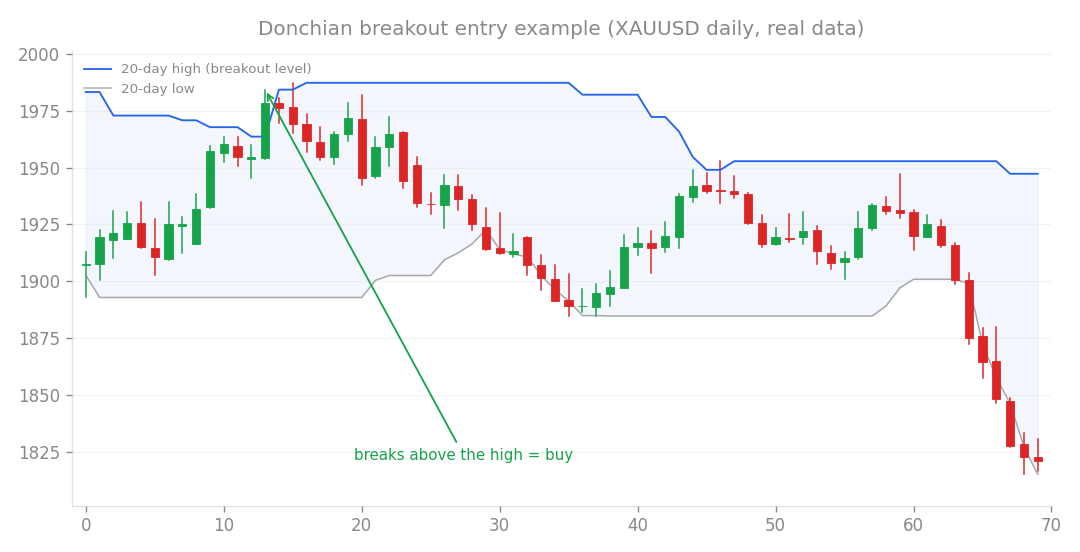
Breakout entry example (XAUUSD daily, real data): buy when price breaks above the recent high.
Sometimes, the best optimization is no optimization at all. We’ve often focused on making our Expert Advisors (EAs) smarter about when to enter a trade. But what about when to leave? This time, we set our sights on optimizing the exit strategy for our core trend-following system, BreakoutLong. The idea behind focusing on exits is that improving how you manage an already established “edge” (your trading advantage) might carry less risk of overfitting compared to tweaking entries. It’s like improving your car’s braking system versus trying to make it accelerate faster – both matter, but one might be a safer bet for overall performance.
What’s the idea?
Our existing BreakoutLong system uses a channel based exit, which is a pretty standard way to trail a stop loss. We wanted to see if we could improve upon this. We introduced two new exit_mode options:
- Chandelier Exit: This is a popular trailing stop indicator that places stops based on the Average True Range (ATR).
- ATR (Average True Range): This measures market volatility. A higher ATR means the market is moving more, so the Chandelier Exit would set a wider stop loss, giving the trade more room to breathe.
- Both: A hybrid approach, trying to combine the strengths of both the
channelandchandelierexits. The goal was simple: Could these new exit methods make our BreakoutLong system more profitable and robust?
How I tested it
I put these new exit modes through their paces using our BreakoutLong EA across four major FX pairs. I tested them on two different timeframes: H1 (1-hour chart) and H4 (4-hour chart), and over the entire available historical data. To compare performance, I focused on a key metric: r/DD (Return / Drawdown). This is a crucial indicator because it tells us how much profit we’re making for every unit of risk (drawdown) we’re taking. A higher r/DD means better risk-adjusted returns – in other words, you’re getting more bang for your buck!
What happened?
At first glance, the results on the H1 timeframe looked promising! When using the Chandelier Exit set to 6ATR (meaning the stop was placed 6 times the ATR away from the price), it outperformed our standard channel exit. The chandelier6ATR had an r/DD of 6.74, while the channel exit came in at 5.72. That’s a noticeable improvement in risk-adjusted returns!
But here’s where things got tricky, and the red flags started waving:
- Parameter Sensitivity: When I tweaked the Chandelier Exit’s ATR multiplier to
3-4ATRinstead of6ATR, the performance actually worsened. This immediately tells us the system is very sensitive to its parameters, which is a sign of fragility. - Timeframe Sensitivity: Even more concerning, when I switched to the H4 timeframe, the
chandelier6ATR(which looked so good on H1) turned out to be the worst-performing exit mode! This kind of inconsistency across different parameters and timeframes is a classic symptom of overfitting. It means the system might just be “lucky” on a specific setup rather than genuinely robust. It’s like having a special wrench that only works on one particular bolt, but you need a toolkit for all sorts of repairs. The real nail in the coffin came from our period split analysis. This is where we divide the entire historical data into different, distinct market periods (or “regimes”) to see how consistently the system performs. What we found was stark: thechandelier6ATRonly showed superior performance during the most recent period, roughly 2021-2025. This period was characterized by strong trends, particularly a weaker Japanese Yen and stronger gold prices. In contrast, during the earlier period of 2015-2021, the originalchannelexit actually performed better! This proved it: thechandelier6ATR’s seemingly good “overall” performance was entirely dependent on the most recent market regime. It wasn’t a robust improvement; it was just a system that happened to do well in specific, recent market conditions. This is the definition of overfitting – a strategy that looks great on recent history but crumbles when market conditions change.
What I learned
The conclusion is clear and, frankly, a bit humbling: we found no robust improvement from exit optimization either.
Our existing channel based exit strategy for BreakoutLong is already remarkably robust across different market periods. In other words, it’s already the best option we have for consistent performance. Therefore, we’re making no changes to the confirmed system.
We will keep the exit_mode parameter in the EA for backward compatibility, but it’s not there to offer superior performance. It serves as a reminder of our research journey.
This research, following similar findings with entry optimization (from previous studies), reaffirms a crucial lesson: our core trend-following system, BreakoutLong, is already operating near its robust optimal point. There’s very little room left to significantly increase monthly profits purely by tweaking price-based logic within the system. It seems we’ve already squeezed out most of the juice from this particular orange!
How this connects
This verification builds on earlier ones (what failed before and what I tried this time, comparisons between approaches).