
Double Your Gold Profits? New Dual-Entry Strategy for XAUUSD!
## What's the idea?
A beginner-friendly summary of the verification: “Double Your Gold Profits? New Dual-Entry Strategy for XAUUSD!”.
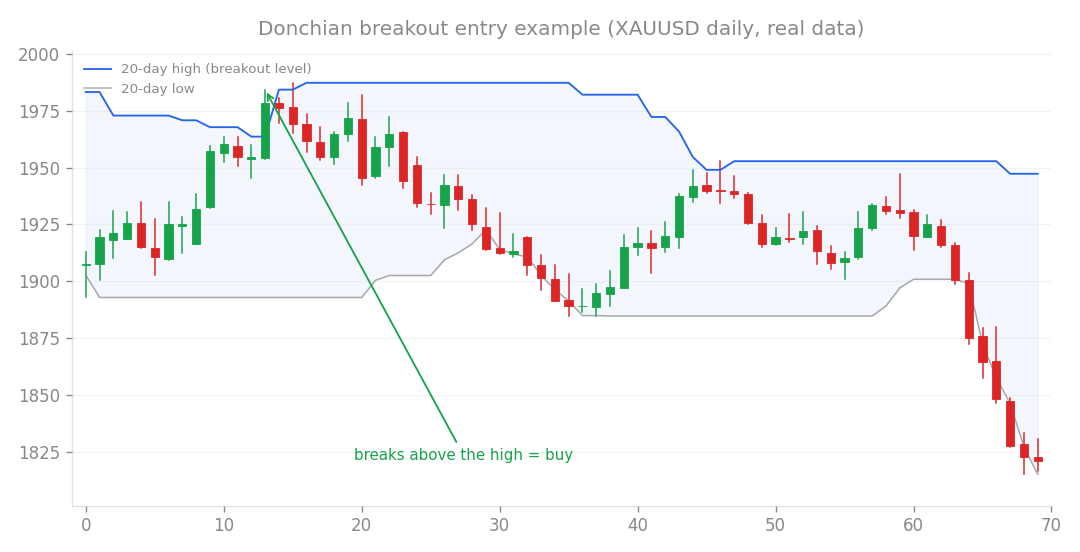
Breakout entry example (XAUUSD daily, real data): buy when price breaks above the recent high.
What’s the idea?
We’re always on the lookout for ways to make our algorithmic trading systems (EAs) even better, and one common approach is diversification. The theory goes that if you combine multiple strategies, especially ones that don’t always move in lockstep, you can smooth out returns and potentially reduce overall risk. This time, we explored combining two different “long” entry strategies for Gold (XAUUSD) to see if we could create a super-strategy. Specifically, we looked at:
- ATRcandle long: A strategy based on Average True Range (ATR) candle patterns, designed to catch upward moves.
- Breakout long: An existing strategy that enters when Gold breaks above a certain price level, also aiming for upward trends.
Both strategies aim to profit when Gold prices rise, but they use different triggers. Our hope was that by running them alongside each other, they might complement each other, picking up trades the other missed, or performing well at different times, leading to a more robust system.
A quick technical note: Our trading engine is designed to hold only one position per symbol at a time. So, to “combine” these two long strategies, we couldn’t just run them simultaneously within one EA. Instead, we ran each strategy completely independently and then merged their trading results afterwards using a process we call
combine_results. Think of it like running two separate businesses and then adding up their profits and losses at the end of the year.
How I tested it
To put this diversification idea to the test, I focused on Gold (XAUUSD) using a 4-hour (H4) chart. The backtest period covered almost a decade, from 2015 to 2024, using clean historical data to ensure reliable results. I evaluated three distinct scenarios:
- Strategy A (ATRcandle long alone): How well did our new ATRcandle strategy perform on its own?
- Strategy B (Breakout long alone): How did our existing Breakout strategy fare in the same period?
- Combined Strategy (A + B): What happened when we merged the results of both independent strategies? To measure performance, I looked at a few key metrics:
- Return / Drawdown (ret/DD): This is a quick ratio to see how much profit we made relative to the largest peak-to-trough decline in our equity (Drawdown, or DD). A higher number is better.
- Sharpe Ratio: This tells us the return earned per unit of risk. Higher is better, as it indicates more return for less volatility.
- Profit Factor (PF): This is calculated as
Gross Profit / Gross Loss. A PF greater than 1 means the strategy is profitable overall. For example, a PF of 1.5 means for every $1 lost, you gained $1.50.
What happened?
The results were quite surprising, and unfortunately, not in the way we hoped!
Here’s how the three scenarios stacked up in terms of their return/DD ratio, along with other key metrics for the best performer:
- Strategy A (ATRcandle long alone): 5.41 (This translated to a +60.5% return, with a -11.2% maximum drawdown, a Sharpe Ratio of 0.90, and a Profit Factor of 1.44).
- Combined Strategy (A + B): 4.86
- Strategy B (Breakout long alone): 2.59
As you can see, Strategy A, the ATRcandle long, was the clear winner by a significant margin. The existing Breakout long (Strategy B) was the weakest performer. But here’s the kicker: when we combined the results of Strategy A and Strategy B, the overall performance (
return/DDof 4.86) was actually worse than Strategy A running by itself (5.41)! In other words, instead of our combined system being stronger than its parts, the weaker strategy actually diluted the performance of the stronger one. It’s like having a champion racehorse and then tying a much slower pony to it – the champion will inevitably slow down.
Why didn’t it work? (The Lessons Learned)
This experiment provided crucial insights into diversification, particularly when strategies are too similar. We identified two main reasons why combining these two Gold long strategies failed to add value:
1. High Correlation: Too Many Eggs in the Same Basket
The primary issue was the high daily correlation of 0.64 between the two strategies. Correlation measures how much two things move together. A correlation of 1 means they move perfectly in sync, 0 means no relationship, and -1 means they move in opposite directions. A 0.64 correlation is quite high, especially for strategies meant to diversify. Both strategies were “Gold long,” meaning they both aimed to profit from rising Gold prices. They were essentially looking at the same asset, in the same direction, on similar timeframes. It’s like having two different fishing boats, but both are trying to catch the same type of fish in the exact same small pond. If the fish aren’t biting, both boats will have a bad day! This is a stark contrast to a previous successful diversification study (Research #20) where strategies had near-zero correlation (0.00). When strategies are uncorrelated, they act more independently, meaning one can perform well when another struggles, leading to smoother overall equity. Here, if Gold wasn’t trending up, both strategies would likely struggle together.
2. Dilution Effect: The Weaker Link
When you combine a strong strategy (A) with a weaker, but highly correlated, strategy (B), the overall performance ratio tends to degrade towards the weaker one. Strategy A was significantly more profitable and efficient than Strategy B. By adding Strategy B’s trades into the mix, we essentially added more risk and less efficient trades to an already excellent system. The good performance of A was “diluted” by the mediocre performance of B. While we did see a slight improvement in drawdown (the combined drawdown was -15.9%, which was slightly better than simply adding up the individual worst drawdowns of -17.6%), this small reduction in risk wasn’t nearly enough to offset the significant drop in overall profitability. A tiny bit of risk reduction, but at too high a cost!
What I learned: The Real Takeaway
The main conclusion is clear: combining two highly correlated “Gold long” entries is not recommended. When strategies are too similar in what they’re trying to achieve on the same asset, you risk redundancy and dilution, rather than true diversification.
However, this research wasn’t a total bust! We found a hidden gem: the ATRcandle long strategy (Strategy A) is clearly superior to our existing Gold Breakout strategy (Strategy B). This is fantastic news!
Instead of trying to combine them, the truly promising path forward is much simpler and more effective: we should replace the existing Gold entry in our final_system with the ATRcandle long strategy. This is a direct upgrade, not a complex combination.
When we evaluated this potential replacement within our proprietary system assessment framework, the numbers were very encouraging: with a small risk allocation (risk 0.003), it showed a projected +43.4% return with only a -9.9% drawdown. It also passed our “STEP1” evaluation and had a worst daily loss of just 1.66%. These are strong indicators that swapping in the ATRcandle long will significantly boost our overall Gold trading performance!
How this connects
This verification builds on earlier ones (what failed before and what I tried this time, comparisons between approaches).