Unlock Hidden Trends: Bill Williams' Fractal Breakout Strategy Exposed!
Today we're diving into Bill Williams Fractals, a popular technical indicator, to see if they hold the key to a profitable algorithmic FX trading stra
A beginner-friendly summary of the verification: “Unlock Hidden Trends: Bill Williams’ Fractal Breakout Strategy Exposed!”.
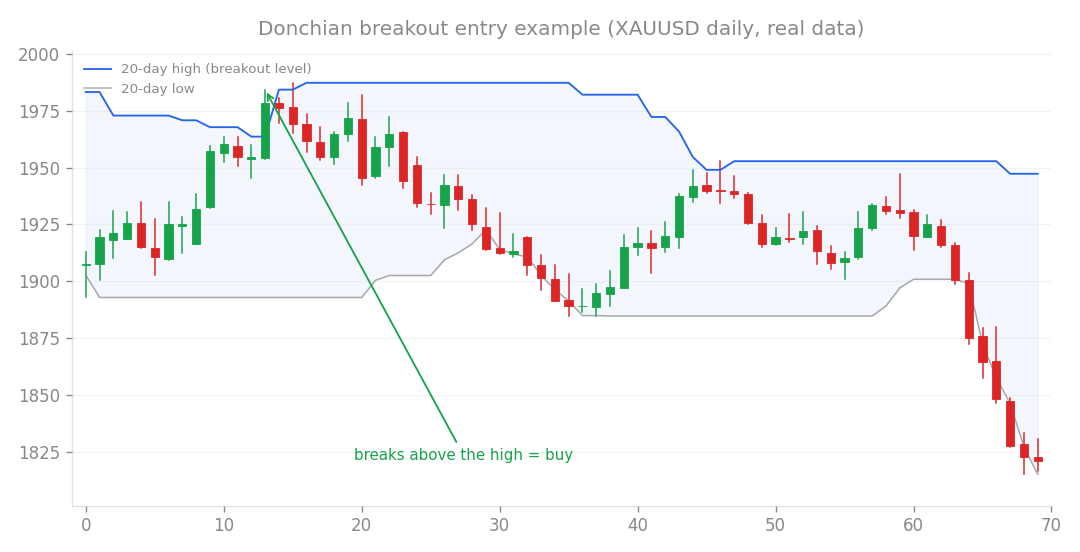
Breakout entry example (XAUUSD daily, real data): buy when price breaks above the recent high.
Today we’re diving into Bill Williams Fractals, a popular technical indicator, to see if they hold the key to a profitable algorithmic FX trading strategy (EA). The idea is simple: can we make money by trading when price breaks out from these fractal highs and lows?
What’s the idea?
A Bill Williams Fractal, in trading terms, isn’t about complex geometry, but a specific price bar that stands out. It’s defined as a bar whose high is the highest (for a “buy” fractal) or whose low is the lowest (for a “sell” fractal) compared to a set number of bars both before and after it. For example, a buy fractal might be a bar that’s higher than the two bars preceding it and the two bars following it. Think of it like spotting a mini-peak or a mini-valley in the price action. The core strategy here is a fractal breakout: when the price moves past a confirmed fractal high, we might consider a ’long’ (buy) trade, expecting the upward momentum to continue. Conversely, breaking a fractal low could signal a ‘short’ (sell) trade. One common pitfall with fractals is “lookahead bias” – where an indicator might seem to work because it “sees” future data. To combat this, we explicitly ensured that a fractal was only confirmed after its formation was complete, shifting and filling the data to the actual confirmation time. This makes our testing much more realistic.
How I tested it
To put this idea through its paces, I designed two main testing scenarios:
- The “Textbook” Approach: This was a straightforward, unfiltered approach using both buy and sell fractal breakouts (what we call a “symmetric” strategy). I tested this across different timeframes: H1 (1-hour), H4 (4-hour), and D1 (daily).
- The “Aligned” Approach: Next, I tried a more refined version. Based on common wisdom, I focused only on ’long’ trades (buying) and added a simple moving average (SMA) filter to try and align with the broader trend. Crucially, I tested these strategies using two rigorous methods:
- Fixed In-Sample/Out-of-Sample (IS/OOS): Imagine you train a robot to perform a task using a specific dataset (in-sample) and then test it on new, unseen data from the same period (out-of-sample). This is a good first step, but it’s still based on a fixed historical chunk.
- Walk-Forward Optimization (WFO): This is the gold standard for EA testing. Instead of one fixed period, we repeatedly optimize the strategy over a short, recent historical period (the “walk-forward window”) and then test it on the immediately following period. We then move the window forward and repeat the process. This simulates how an EA would be managed in real-time, adapting to changing market conditions. It’s much tougher, but gives a far more realistic picture of an EA’s robustness. I looked at key performance metrics like:
- Profit Factor (PF): This is your gross profit divided by your gross loss. A PF greater than 1.0 means your strategy is profitable overall. For example, a PF of 1.5 means for every $1 you lose, you make $1.50.
- Drawdown (DD): The peak-to-trough decline in your capital. A smaller DD is generally better, as it indicates less risk and volatility.
What happened?
Let’s get straight to the results, because they tell a powerful story.
Test 1: The “Textbook” Fractal Breakout
The results from the unfiltered, symmetric fractal breakout were, to put it mildly, devastating:
- H1 (1-hour timeframe): -98%
- H4 (4-hour timeframe): +1%
- D1 (Daily timeframe): -13% In other words, if you started with $100 on the H1 timeframe, you’d be left with just $2! A complete wipeout. This confirmed a known truth: raw, unfiltered symmetric fractal breakouts rarely work consistently, and this test showed them failing completely across most timeframes.
Test 2: The “Aligned” Fractal Breakout (Long-Only + SMA)
Initially, the ‘aligned’ strategy looked promising on fixed IS/OOS tests. It showed:
- D1 (Daily timeframe): A total return of +13.8% over the entire period, with a respectable Profit Factor (PF) of 1.39 and a manageable drawdown (DD) of -5.7%.
- H4 (4-hour timeframe): An even better +24.6% return. Looks great on paper, right? But this is precisely where selection bias and over-optimization can play tricks on us. A strategy can look fantastic if it’s perfectly tuned to a specific historical period, but that doesn’t mean it will perform well going forward. This became painfully clear when I put the strategy through the crucible of walk-forward optimization across multiple currency pairs. The strategy utterly collapsed:
- D1 (Daily timeframe): An overall loss of -8.4% across all tests, with only 1 out of 7 individual walk-forward tests turning a profit.
- H4 (4-hour timeframe): A similar story, with a -5.4% loss and only 3 out of 7 tests managing to stay in the green. In other words, the strategy that looked so good when optimized for a specific historical period simply couldn’t adapt and perform consistently when continually re-optimized for new market conditions. It highlights the difference between a strategy that looks good in hindsight and one that is truly robust.
The Big Reveal: Not an Independent Edge
But here’s the kicker, and perhaps the most interesting discovery: I found a high daily correlation of 0.83 between this fractal breakout strategy and a known robust ‘Trend Core’ breakout strategy. What does a correlation of 0.83 mean? It means these two strategies moved very much in sync, generating similar signals at similar times. In essence, the Bill Williams Fractal breakout wasn’t really discovering a new unique trading advantage. It was effectively acting as a ‘swing high/low detector’ – essentially reinventing the wheel, or rather, rediscovering something very similar to a Donchian Channel breakout. Donchian Channels are famous for capturing breakouts from price channels. So, while fractals look different, their actual trading signals in this context were highly redundant with an established, simpler concept.
What I learned
This deep dive into Bill Williams Fractals taught us some crucial lessons about verifying EAs:
- Beware of Fixed IS/OOS Results: What looks fantastic in a fixed historical period (high returns, good PF) can be a mirage, often due to selection bias or over-optimization. Always be skeptical of results that haven’t been rigorously tested.
- Walk-Forward Optimization is King: It’s the ultimate stress test for an EA’s robustness and adaptability. If a strategy can’t survive WFO, it’s unlikely to thrive in live trading. Don’t skip this step!
- Independent Edge Matters: Just because an indicator looks unique doesn’t mean it provides an independent trading edge. Sometimes, you’re just finding a more complex way to identify signals already captured by simpler, more established methods (like Donchian Channels in this case). Always ask: “Is this truly unique, or just a dressed-up version of something else?”
- No Robust Edge Here: Ultimately, Bill Williams Fractals, when tested rigorously in this breakout context, didn’t provide a robust, forward-stable edge. They join the ranks of many standard technical indicators that, on their own, struggle to consistently beat the market in an automated fashion. This doesn’t mean fractals are useless for discretionary traders who combine them with other analysis and market context, but for automated systems seeking a clear, persistent edge, they fell short. This research reinforces the idea that true edges are hard to find and require incredibly robust verification!