Your EA's Emergency Brake? How Auto-Risk Adjustments Save Your Trades!
## What's the big idea here?
A beginner-friendly summary of the verification: “Your EA’s Emergency Brake? How Auto-Risk Adjustments Save Your Trades!”.
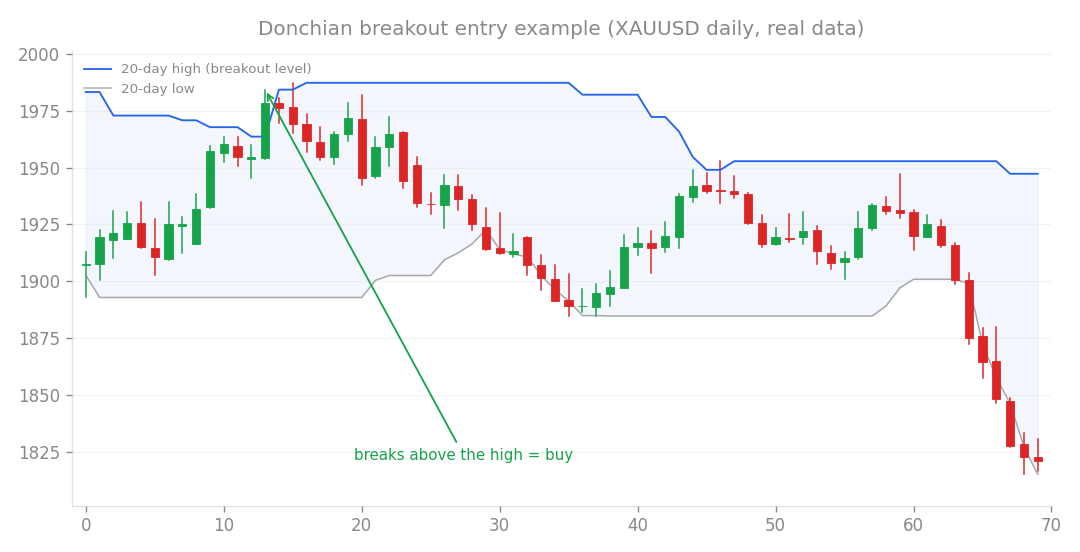
Breakout entry example (XAUUSD daily, real data): buy when price breaks above the recent high.
What’s the big idea here?
Today, we’re diving into a strategy that combines a core trend-following approach with a clever risk management layer I call an “equity overlay.” The main goal of this particular experiment was to see if we could reduce the dreaded drawdown – that temporary decline in your trading account balance – without sacrificing too much profit. The core of the strategy is built on identifying long-term trends, a classic “edge” in trading. But the twist comes from the “equity overlay.” Here’s how it works: if your trading account’s equity (your current balance) drops below its 60-day Moving Average (MA) – essentially, if your account performance has been weaker than its recent average – the EA automatically halves your risk per trade. Think of it like tightening your belt when your finances are a bit lean. The idea is to protect capital during rough patches, so you’re still around when the good times return.
How I put it to the test
To give this strategy a rigorous workout, I tested it on a diverse basket of 5 major pairs and assets: Gold (XAU/USD) and the Yen crosses (USD/JPY, GBP/JPY, EUR/JPY, CHF/JPY). All testing was done on the H1 (hourly) timeframe. Initially, I set the risk per trade at a conservative 0.4% of the account balance. This is a common starting point for robust testing. I also ran Monte Carlo simulations, which are like running the strategy thousands of times with slightly different conditions, to see how robust it truly is under various market scenarios.
So, what happened? (The Results!)
This is where it gets interesting, and we see the classic trade-offs in algorithmic trading.
The Good News: Drawdown Reduction!
The equity overlay did work in reducing drawdown (DD). The maximum drawdown dropped from 17.4% to 15.2%. In other words, the biggest temporary dip in the account balance was reduced by about 13%. That’s a noticeable improvement in capital preservation, which is always a win in my book!
The Catch: Returns Also Dropped
However, this reduction in drawdown wasn’t “free.” The monthly returns also saw a proportional decrease, falling from 0.99% to 0.76%. So, while we had less risk exposure, we also earned less during the testing period. This is a key takeaway: often, strategies designed to reduce drawdown will also temper returns. It’s a balance you constantly have to manage.
How it Stacked Up Against a Benchmark
I compared these results to a similar, well-performing benchmark strategy (referred to as the “fto version” in my notes) that had achieved an “asymmetrical” drawdown reduction – meaning it cut DD significantly (from 32% to 20%) without such a proportional hit to returns. My current equity overlay didn’t quite achieve that level of efficiency. Why not? Well, part of it comes down to the MA lag. A Moving Average, by its nature, reacts to past data. This lag meant that the strategy was sometimes late to reduce risk when a downturn started, and also late to increase risk again when the market was recovering, essentially “cutting into” potential recovery phases. My current implementation also likely isn’t fully optimized, leaving room for improvement.
Pushing the Risk: Limited Benefits
I also explored increasing the risk slightly to 0.6% per trade to see if it improved the return-to-drawdown ratio. While monthly returns edged up to 1.07%, the drawdown also climbed significantly to 22%. This wasn’t a desirable trade-off. The Monte Carlo simulations for this higher-risk setting painted a stark picture:
- Only 62% of the simulations showed overall success.
- A concerning 22% of the simulations ended in “disqualification due to maximum loss,” meaning the account effectively blew up. This tells me that while the average return might look okay, the probability of catastrophic failure at this risk level is too high.
What I Learned (Key Takeaways)
This project offered some valuable insights into the realities of automated trading:
- Realistic Expectations: Based on these tests, for a “safe” drawdown (below 10%), you might expect around 0.5% monthly returns. If you’re willing to be more aggressive, aiming for around 1% monthly, you’d likely face a drawdown closer to 15%. Crucially, these figures are also regime-dependent, meaning performance can vary significantly with different market conditions.
- The “Ceiling” of Price Data: This project successfully managed to isolate and quantify a genuine “edge” based purely on long-term trends from price data. It confirmed that these trends are indeed economically viable. However, the results also suggest that there might be a “ceiling” to what can be achieved with price data alone.
- Beyond Price Data: To achieve significantly higher returns or even more asymmetrical drawdown reduction, the next frontier likely lies in incorporating non-price data – things like interest rate differentials (carry trade concepts) or other fundamental economic indicators. That’s a whole other ballgame!
- Reliable Testing Foundation: Even if this specific iteration of the equity overlay didn’t hit all its targets, the good news is that the underlying testing framework and verification process for this EA are robust and reliable. This means we can trust the data and use this solid foundation for future explorations and optimizations. In short, while the equity overlay did reduce drawdown, it came at a cost to returns, and wasn’t as efficient as some benchmarks. It highlights the constant balancing act between risk and reward in algorithmic trading and points to where we might need to look for further innovation.