Power in Numbers: How Combining Weak EAs Boosts Success & Stability

Trend · 5 min

## What's the idea?

A beginner-friendly summary of the verification: “Power in Numbers: How Combining Weak EAs Boosts Success & Stability”.

Breakout entry example (XAUUSD daily, real data): buy when price breaks above the recent high.

Breakout entry example (XAUUSD daily, real data): buy when price breaks above the recent high.

What’s the idea?

Today, we’re diving into a fascinating approach to building robust trading systems: combining multiple “weak edges” that don’t necessarily move in lockstep. Think of it like having several small, consistent fishing spots that are unlikely to all go dry at the same time. Individually, each spot might not yield a huge catch, but together, they create a much more reliable and stable supply. The goal here is to create a diversified portfolio of uncorrelated strategies, each with a slight advantage, to achieve low drawdown (DD) and high stability – a real path to consistent withdrawals.

How I tested it

To really put this idea through its paces, I used a couple of rigorous testing methods.

Monte Carlo Simulations for Robustness

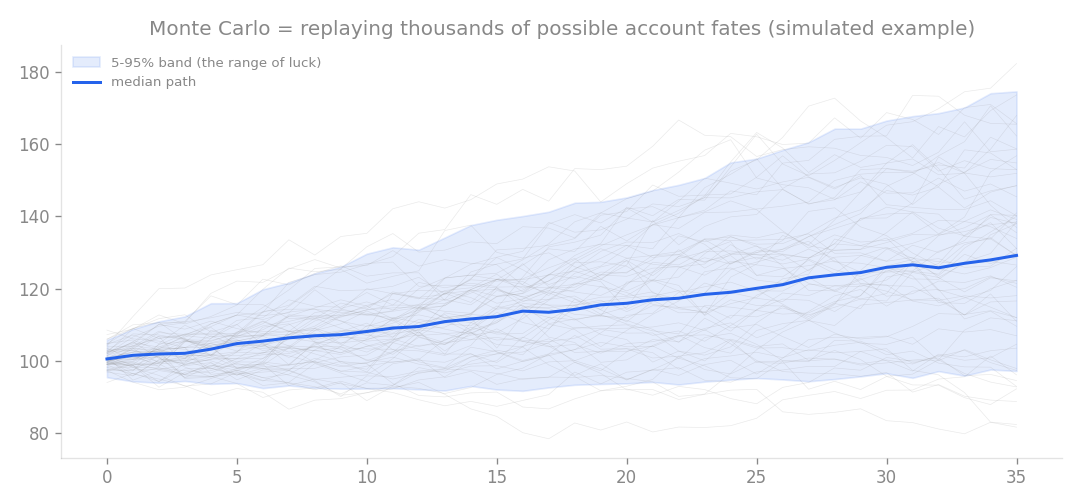
First up, I ran extensive Monte Carlo simulations. If you’re new to this, imagine running your trading strategy hundreds, even thousands, of times, each with slightly different starting conditions or market sequences. It’s like seeing how your strategy performs across a vast range of possible futures, rather than just one historical path. For this test, I simulated an “unlimited” 750-day trading period, focusing on a specific risk level for each individual strategy, or “component,” in the portfolio. “Risk per component” simply means the percentage of your total account balance that each single EA is allowed to risk on any given trade.

Intraday Validation for Real-World Safety

Beyond the long-term Monte Carlo, it’s crucial to see how a strategy behaves in the thick of daily trading. So, I conducted a dedicated intraday validation using M1 (1-minute) timeframe data from 2022 to 2025. This test focuses on the nitty-gritty details of how the strategy performs minute-by-minute, ensuring it doesn’t have hidden vulnerabilities during active market hours.

What happened?

The results from these tests were quite encouraging!

Monte Carlo Results: A Solid Foundation

When running the Monte Carlo simulations with a 1% risk per component, the results were:

  • 77% passed the initial qualification step.
  • 64% passed the overall test. This means that nearly two-thirds of the time, this diversified approach successfully navigated 750 days of simulated trading without hitting critical failure points.
  • Only 9% failed due to maximum loss limits, and for those that did fail, the median time to failure was 261 days. Here’s a key insight: The strategy exhibited a low drawdown (DD). In other words, the typical dips in account equity were relatively small. This low DD suggests there’s actually room to increase the risk per component, which could, in turn, significantly boost the overall pass rate. However, there’s a sweet spot! Pushing the risk above 1.5% per component started to see an increase in failures due to hitting maximum loss limits. It’s like turning up the volume on your speakers – a little more can make it better, but too much just creates distortion.

Intraday Validation: Smooth Sailing!

The dedicated intraday test (at 1.5% risk per component, from 2022-2025) delivered excellent results:

  • A healthy +35.8% profit over the period.
  • A Profit Factor (PF) of 1.52. For those unfamiliar, Profit Factor is simply your gross profit divided by your gross loss. A PF greater than 1 means you’re profitable, and 1.52 is a very respectable number – it means for every $1 lost, the strategy made $1.52 in profit!
  • The worst daily loss was only 2.67%.
  • Crucially, there were zero daily disqualifications and no hidden failures (meaning no unexpected issues that might slip past standard performance metrics). This is a huge win! Unlike some strategies that might struggle when all their components are exposed to similar market conditions (e.g., during volatile intraday moves), this diversified approach prevented multiple components from crashing simultaneously. It also showed a reduced tendency to “give back” floating profits, which is critical for turning paper gains into real, realized profits. This level of stability and safety during intraday trading is decisive, especially for those looking at prop trading opportunities.

What I learned & Next Steps

This research confirms that the approach of diversifying uncorrelated “weak edges” is a powerful one. It leads to low drawdown, high stability, a respectable ~64% long-term pass rate, and safe intraday performance. This truly feels like a realistic and sustainable path towards consistent withdrawals in FX trading. However, we’re not quite ready for live deployment yet! There are still a couple of absolutely critical validations remaining:

  1. Walk-Forward Analysis (WFA): This is perhaps the most important pre-live test. WFA helps us eliminate “selection bias” – the risk of accidentally building a system that looks fantastic purely because it’s perfectly tuned to past data, not because it actually works on new, unseen market conditions. We need to perform an Out-of-Sample (OOS) test that includes the component selection process itself. For example, we’d choose the best-performing components based on data from 2016-2021, and then combine and test that chosen portfolio on completely fresh data from 2022-2024. This ensures our selection method is robust, not just the final combination.
  2. Tail Risk Management: We need to explicitly address “tail risk,” which refers to rare, extreme market events like the COVID-19 crash in 2020. This means either adopting a more conservative risk setting across the board or implementing specific crisis detection mechanisms that can temporarily adjust risk during such periods. Based on our findings, a recommended operating risk level would be around 0.7-1% per component. This range has been shown to keep the total portfolio drawdown to approximately -10% even during the entire turbulent 2020 period, offering a good balance of performance and safety.