
Our Promising EA Vanished: How Future Data Exposed a False Edge
## What's the idea?
A beginner-friendly summary of the verification: “Our Promising EA Vanished: How Future Data Exposed a False Edge”.
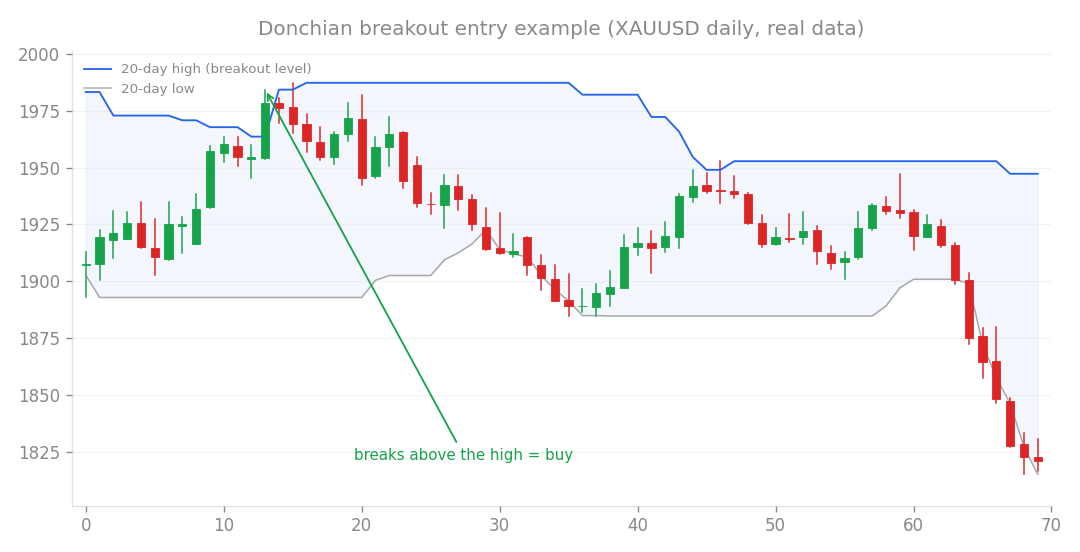
Breakout entry example (XAUUSD daily, real data): buy when price breaks above the recent high.
What’s the idea?
You know how exciting it is to find an Expert Advisor (EA) strategy that looks incredibly profitable in backtests? Well, we’ve been digging deep into some of those promising candidates, especially one involving a Donchian channel strategy on Gold, which initially showed a whopping +21.8% profit. The big question we’re always trying to answer is: Is this a real “edge” – a genuine statistical advantage that will keep making money – or just a fluke? To truly answer that, we need to work with “clean data.” Think of it like a chef needing fresh, unadulterated ingredients. In trading, “clean data” means making sure our historical price information is free from any errors or, crucially, any “future data leakage” (also known as look-ahead bias). This is where information from after a trade would have occurred accidentally creeps into the data used to decide on the trade, making the strategy look much better than it ever could in real life. It’s like seeing tomorrow’s newspaper headlines today – you’d make a killing, but it’s not a realistic scenario!
How I tested it
Our mission was to perform a “clean rescan.” This meant going back to square one, re-evaluating our top-performing strategies using only the most rigorously checked, squeaky-clean data. For the Gold Donchian strategy, this specifically involved correcting an issue where some data from as far out as 2026 had somehow found its way into our historical records. Yes, you read that right – 2026! Obviously, having future data makes any strategy look amazing. Removing this phantom data was critical. Beyond Gold, we also cast a wider net. We systematically tested around 80 different combinations of popular currency pairs and standard technical indicators like ADX (Average Directional Index, which measures trend strength) and RSI (Relative Strength Index, which measures momentum). We wanted to see if any of these common, well-understood tools could reveal a consistent, reliable edge when applied to clean, currency-specific data over several years.
What happened?
The Gold Donchian Reality Check
The first big revelation came from our Gold Donchian strategy. After removing the problematic 2026 data – effectively pulling back the curtain on its artificial success – its impressive +21.8% profit figure absolutely cratered. It shrank dramatically to just +5.3% over the entire period, which works out to a meager +0.8% annually. In other words, what looked like a goldmine was mostly a mirage created by accidentally “seeing the future.” This stark reduction really drives home how vital data quality and preventing future data leakage are. Without truly clean data, you’re just building castles on sand!
The “Top” Performers (and why they’re not)
Next, we looked at the best performers from our 80-strategy clean rescan. While we did find a few strategies that showed some positive returns, they were all incredibly weak. Here are the “highlights”:
- USDJPY x Trend+ADX: This combination yielded +10.5% over 6-7 years. Sounds okay, right? But the worst year saw 0.0% profit, and overall, it averaged only +1% to +1.6% annually.
- EURJPY x RSI: This strategy gave +9.2% over 5-7 years, also averaging +1% to +1.6% annually.
- GBPNZD x RSI: Another contender with +8.7% over 6-7 years, again in the +1% to +1.6% annual range. While these are technically positive, they are far from impressive. More importantly, when you test 80 different variations, the chances of some of them looking profitable just by random luck are quite high. This is known as “multiple testing bias.” Imagine throwing 80 darts at a board blindfolded; you’re bound to hit the bullseye once or twice just by chance. That doesn’t make you a dart-throwing champion! We concluded that these weak candidates are highly likely just products of chance from our extensive testing, not genuine, reliable edges.
What I learned
The Big Takeaway
The ultimate conclusion from this round of research is a sober one: we could not find a strongly reliable edge using standard technical indicators, even with rigorously clean data and strategies specialized for individual currency pairs. While we identified some weak candidates, they simply don’t generate the kind of robust, consistent returns (like the +8% annual target often aimed for in proprietary trading) needed to be genuinely trustworthy or scalable. This doesn’t mean technical indicators are useless in all contexts. But for finding a strong, statistically significant, and consistently profitable edge for automated trading, they appear to fall short when put under intense scrutiny.
Where to go from here
So, if standard technical analysis isn’t providing the strong edge we’re looking for, what are the next realistic steps?
- Original Ideas & Different Data: The most promising path is to explore entirely new, unique trading ideas or incorporate different types of data beyond just price action. Think outside the box!
- Calculated Risk: For those looking to get into proprietary trading, it might be more realistic to view it as a smaller, carefully calculated risk rather than a guaranteed high-return venture based on conventional methods.
- Different Markets/Methods: Perhaps the FX market with standard indicators is simply too efficient. We might need to explore other markets (like commodities or indices) or entirely different methodologies (e.g., machine learning, fundamental analysis).
The Undeniable Win
Even though we didn’t uncover a new “holy grail” strategy, this research yielded an incredibly valuable and enduring achievement: we’ve built a robust, reliable framework for identifying and rejecting false edges, even those hidden by data quality issues. This multi-stage process helps us filter out strategies that look good on paper but are ultimately flawed. Knowing what doesn’t work, and why it doesn’t work, is just as important as finding what does. It’s a critical foundation for any serious EA development, ensuring we don’t chase mirages and instead focus our efforts on truly promising avenues.