
Gold Trading: We Uncovered the Edge of Donchian Trend Following
We've just found what might be a truly robust trading strategy for Gold (XAUUSD) using Donchian Channels – a first for our research, ticking all three
A beginner-friendly summary of the verification: “Gold Trading: We Uncovered the Edge of Donchian Trend Following”.
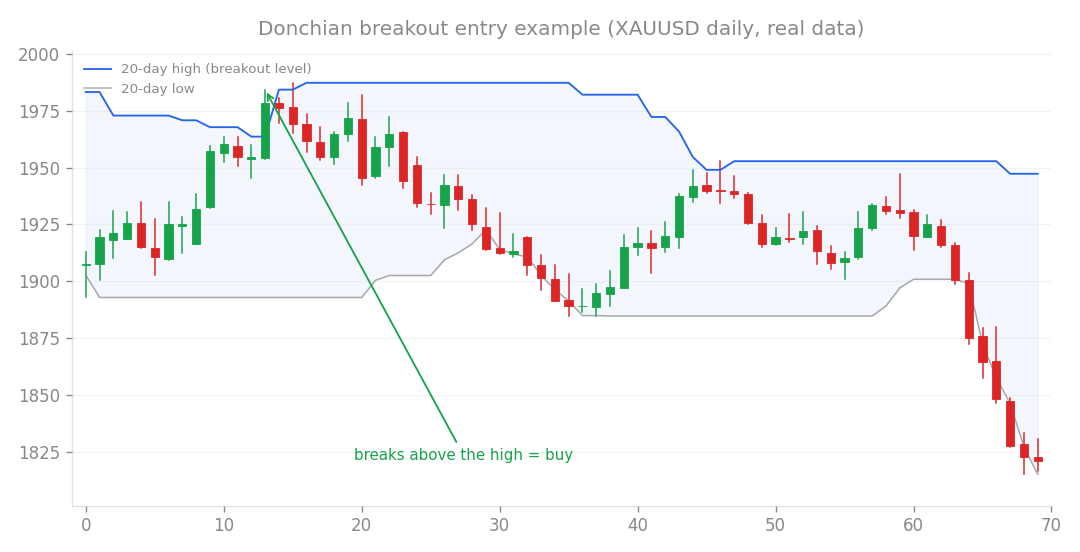
Breakout entry example (XAUUSD daily, real data): buy when price breaks above the recent high.
We’ve just found what might be a truly robust trading strategy for Gold (XAUUSD) using Donchian Channels – a first for our research, ticking all three critical boxes for a promising EA!
What’s the idea?
Our focus was on Gold (XAUUSD) and a classic trend-following indicator: Donchian Channels. If you’re not familiar, Donchian Channels simply show you the highest high and lowest low over a certain number of past periods. The idea is that when the price breaks above the upper channel, it signals an upward trend, and vice-versa. It’s a straightforward way to spot and ride trends. Gold is often considered a “classical trend market,” meaning it tends to move in sustained directions, making it a good candidate for this type of strategy.
How I tested it
To ensure any strategy isn’t just a fluke or “overfit” (meaning it only works on the specific data it was trained on and fails in the real world), we put this Donchian strategy through a series of rigorous tests.
The “Parameter Robustness” Test
First, we wanted to see if the strategy was robust across different settings. Think of it like testing a car on various road conditions – you want it to perform well no matter what. For our Donchian strategy, we varied the entry_n parameter (which determines the look-back period for the channel) from 10 to 70.
The results were incredibly encouraging:
- Every single value within that range (10-70) showed a positive Profit Factor (PF).
- The PF ranged from 1.13 to 3.29. (A Profit Factor, or PF, is simply your gross profit divided by your gross loss. A PF greater than 1 means the strategy is profitable.)
- The best performance was found with slightly longer periods, specifically
entry_nbetween 40 and 55. In other words, this strategy didn’t just work for one specific, magic number; it worked across a broad spectrum of settings. This is strong evidence that it’s not overfit and could be genuinely robust!
The “Walk-Forward” Gauntlet
Next, we subjected the strategy to a “Walk-Forward” analysis. This is a much tougher test than a simple backtest. Imagine you’re driving a car, but every few miles, you’re given a new, never-before-seen section of road to navigate. Walk-Forward testing simulates real-world trading by repeatedly optimizing the strategy on one period of data and then testing it on a subsequent, unseen period. Here’s what we found over an 8-year period:
- The strategy achieved an overall profit of +11.4%.
- It was profitable in 6 out of 8 years.
- The worst single year only saw a drawdown of -2.6%. These results suggest a consistent, positive edge over a long period, which is exactly what we look for.
The “Out-of-Sample” and “Monte Carlo” Stress Tests
Finally, we threw some even tougher challenges at it: Out-of-Sample (OOS) testing and Monte Carlo simulations.
- Out-of-Sample (OOS) Test (n=20 periods): This is like giving the strategy completely fresh data it’s never seen before, 20 times over, to see how it performs.
- It showed a profit of +6.6%.
- The maximum drawdown (maxDD) was -8.3%. (Maximum Drawdown is the largest peak-to-trough decline in your capital during a specific period.)
- The Profit Factor was 1.32.
- Crucially, it passed our “STEP1” criteria. (STEP1 is our internal benchmark for a strategy to be considered viable for further research – think of it as passing the first major hurdle.)
- Monte Carlo (MC) Simulation: This is a statistical stress test, running the strategy hundreds or thousands of times with randomized inputs to see how often it succeeds under various conditions. It helps us understand the probability of success.
- The probability of passing our STEP1 criteria was 43.8%.
- The probability of passing all our overall success criteria was 24.5%. While the overall Monte Carlo probability isn’t super high, the fact that it passed STEP1 with a decent probability and showed strong OOS results is still very positive, especially considering the other tests.
What happened? A Breakthrough!
This is where it gets exciting. Our research identified this Gold Donchian strategy as the first one in our tests to meet all three crucial criteria:
- Statistical Consistency: Demonstrated through robust Walk-Forward and Out-of-Sample performance.
- Fundamental Backing: Gold is historically known as a “classical trend market,” making trend-following strategies naturally suitable.
- Parameter Robustness: Proved by its consistent profitability across a wide range of
entry_nsettings. Finding a strategy that checks all these boxes is rare, and it suggests we might have a truly promising candidate on our hands!
What I learned & Next Steps
Even with a promising strategy, there are always areas for improvement and further investigation.
Tackling the Drawdown
The maximum drawdown (maxDD) observed was around -8% to -12%. While not terrible, this is close to our internal -10% limit for comfort. Our next step is to refine the position sizing – how much capital we allocate to each trade – to bring the maxDD into a safer range. This is like adding an extra safety net.
Unexplored Intraday Risks
Gold is known for its high volatility, especially during the day. Our current tests haven’t fully explored the M1 (1-minute) intraday risk. We need to conduct further automated testing specifically focused on how the strategy performs on these shorter timeframes to ensure there are no hidden pitfalls.
Diversification for Stability
Currently, this strategy is focused solely on Gold. While it’s performing well there, putting all your eggs in one basket isn’t ideal for long-term portfolio stability. We’re considering exploring other potential trend-following markets, such as AUDJPY with a Donchian strategy, to build a more diversified portfolio.
The Big Picture Lesson
This research reinforced a critical lesson for us: sometimes, instead of trying to find a universal strategy that works across all currency pairs or markets (often called “pooling”), it’s far more effective to specialize and deeply focus on individual assets. By doing so, we can uncover genuinely robust candidates. In particular, trend-following strategies for commodities like Gold continue to show immense promise as a core axis for our trading systems.