EA Research Unveiled: The Honest Truth About Simple Strategies & What's Next
This post is a wrap-up of our recent deep dive into verifying algorithmic FX trading strategies, specifically focusing on a range of simpler Expert Ad
A beginner-friendly summary of the verification: “EA Research Unveiled: The Honest Truth About Simple Strategies & What’s Next”.
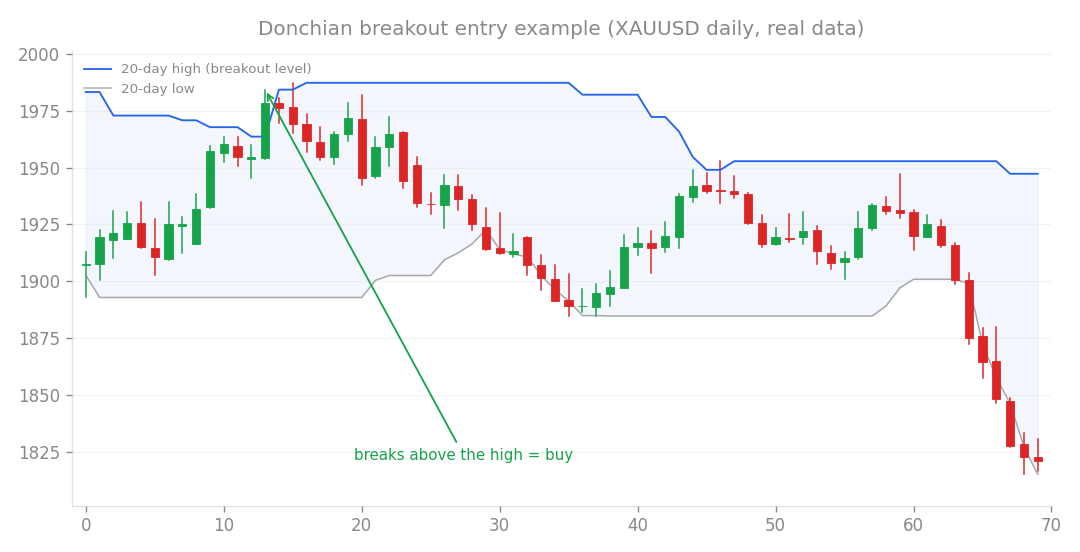
Breakout entry example (XAUUSD daily, real data): buy when price breaks above the recent high.
This post is a wrap-up of our recent deep dive into verifying algorithmic FX trading strategies, specifically focusing on a range of simpler Expert Advisors (EAs).
What Was I Testing?
For this research phase, I concentrated on EAs built around single-indicator technical analysis. Think of the classics:
- EMA (Exponential Moving Average): A popular trend-following indicator, smoothing out price data.
- Donchian Channel: A volatility and trend indicator, often used for breakout strategies.
- Trend + ADX (Average Directional Index): Combining a basic trend filter with ADX to gauge the strength of that trend.
- RSI (Relative Strength Index): A momentum oscillator, signaling overbought or oversold conditions. I applied these strategies across various markets and timeframes:
- JPY FX pairs: On both H4 (4-hour) and D1 (daily) charts.
- Metals (e.g., Gold/Silver): On D1 (daily) charts. The goal was straightforward: could any of these fundamental, single-indicator approaches provide a consistent edge in these markets?
How I Put These EAs to the Test
To truly test the robustness of these strategies, I employed walk-forward testing. This is crucial! Instead of just optimizing a strategy on all available historical data (which is like tailoring a suit only for one specific party), walk-forward testing simulates real-world trading. You optimize the EA on a segment of historical data, then test it on a new, unseen segment, then repeat this process by “walking forward” through time. It’s the best way to see if a strategy can adapt and perform outside of its training period. Even if the strategies themselves didn’t pan out (spoiler alert!), a major win from this phase was the establishment of a highly reliable verification infrastructure. This isn’t just a fancy term; it’s the core of capital preservation. It means we now have robust systems for:
- Data conversion and processing.
- A powerful backtesting engine.
- GPU optimization and parallel processing for lightning-fast tests.
- Prop firm evaluation tools to simulate real-world challenge conditions.
- Portfolio account management for analyzing multiple strategies.
- And, of course, the walk-forward testing mentioned above. In other words, we’ve built the ultimate “bad strategy rejection machine.” Being able to confidently say “this strategy doesn’t work” is just as valuable—if not more so—than finding one that does, because it protects your capital from being wasted on false hopes.
So, What Did We Find? (The Big Reveal)
Here’s the punchline: None of the single-indicator strategies I tested demonstrated a robust, sustainable edge when subjected to rigorous walk-forward testing. What does “robust edge” mean? It means a consistent, reliable profitability that isn’t just due to luck or specific market conditions. A truly robust strategy would show a consistently high Profit Factor (PF = total gross profit / total gross loss; anything above 1.0 means profitable, but we aim much higher for real robustness!) across different market conditions, not just isolated periods. Any seemingly good results I found were highly period-dependent. This is a classic sign of over-optimization (fitting a strategy too perfectly to past data, making it brittle in the future) or simply pure chance. It’s like finding a shiny coin on the sidewalk once; it doesn’t mean you have a reliable income stream. This outcome was actually within my expectations. The Efficient Market Hypothesis suggests that all available information is already priced into assets, making it incredibly difficult for simple technical analysis to yield a sustained advantage. Continuously trying out a multitude of simple strategies, hoping one will stick, is a dangerous game known as data snooping. It significantly increases the risk of finding “false positives”—patterns that look profitable in historical data but have no predictive power in the future.
What Does This Mean for Our Next Steps?
This research phase, while not yielding a “holy grail” strategy, provided invaluable insights and a powerful toolkit. It forces us to consider our path forward. Here are the options we’ve been weighing (and that you might consider for your own EA journey):
- Embrace More Advanced Methodologies: Move beyond single indicators to ensemble methods (combining multiple strategies), regime-composite strategies (adapting to different market conditions), exploring alternative data sources, or even incorporating discretionary (human) assistance with algorithmic execution.
- Re-evaluate Our Goals: There’s a big difference between aiming for a one-time pass of a prop firm challenge and achieving consistent, sustained withdrawals from live trading. Passing a challenge might be achievable with calculated risk and diversification, but consistent, long-term profitability absolutely demands a true, robust edge, which is significantly harder to find.
- Integrate User-Specific Insights: Leverage unique hypotheses, proprietary data, or individual market insights that aren’t widely available.
- Explore Alternatives to Prop Firms: Consider other avenues for capital deployment if prop firms aren’t the right fit. After careful consideration, we’ve decided to adopt Option (B) as our immediate next step: We will quantify exactly what it takes to pass a prop firm challenge. This will involve reverse-engineering the requirements and building strategies specifically with that goal in mind. It’s a concrete, measurable objective that, while not the ultimate goal of consistent personal withdrawals, provides a valuable intermediate target and a recommended flow for many aspiring traders. Stay tuned as we dive into this next phase of research!